Increase product capacity, save energy, shorten production time and ensure reproducibility - all this is possible with the new ProPhi pre-grinding unit from NETZSCH.
This new technology improves your dispersion process so that all subsequent production steps benefit. With the ProPhi you will reduce your premixing process time by up to 50% and your cleaning effort for large batches. In addition, you can process sedimentation-prone materials and fluctuating raw material qualities without jeopardizing your process reliability.
Focus on Your Advantages
- High product quality: for stable rheological product properties (no sedimentation after pre-dispersion)
- High process reliability, even with fluctuating raw material qualities
- Sustainable production
- Reduction in energy consumption by up to 30%
- Minimal cleaning effort for large batches
- Reduction in investment costs and spare parts through the use of highly resistant materials
- Smaller grinding beads can be used for fine grinding - conditional energy savings
- High productivity: reduction of the premixing process time by up to 50%


What challenges do you master with the NETZSCH ProPhi?
The NETZSCH ProPhi crushes difficult-to-handle coarse material with the most effective physical operating principles. Pre-dispersion of agglomer-ates, which is usually carried out discontinuously or continuously in intensive mixing units, can also be carried out without any problems. This re-quires prior introduction of the solids into the liquid phase. A major challenge in the continuous preparation of coarse suspensions is their ten-dency to sedimentation, which can be solved by a correspondingly high flow rate and a high product throughput.
When do you use the NETZSCH ProPhi in your production process?
- For formulations with crystalline active materials
- For formulations that are often pre-ground with so-called colloid mills and must achieve a fineness of <100 µm
- For abrasive and sedimentary products, that lead to clogging of agitator bead mills during the subsequent fine-grinding process
- For batch sizes up to 10 m³
ProPhi 4 | ProPhi 20 | ProPhi 60 | |
|---|---|---|---|
| Power [kW] | 7.5 | 30 | 55 |
| typical Flow Rate [l/h]* | 300 - 2 500 | 2 000 - 10 000 | 3 000 - 20 000 |
| Bead Size [mm] | 1.2 - 4 | 1.2 - 4 | 1.2 - 4 |
| Grinding Chamber Volume [l]* | 4 | 20 | 60 |
| typical Batch Size [l]* | up to 100 | up to 6 000 | up to 12 000 |
*reference value
Features of the NETZSCH ProPhi
Pump power adjustment independent of rotor speed
High energy density
- Highly efficient ICC separation system:
- For a high flow rate
- For dynamic separation of grinding beads
- Adapted to the product requirements
- Grinding beads from 2 mm - 4 mm diameter
- Variable grinding media fill level, adjustable to the product specifications
- Circulation grinding with highest flow at lowest pressure (process ~ 1.2 bar - 1.5 bar):
- Prevents sedimentation in the pipelines
- Provides for the necessary batch turnover with low specific energy input to the product

Highly Efficient Process Engineering
Pre-grinding in an agitator bead mill is many times more efficient and effective than pre-dispersion with a high-speed dissolver, a rotor/stator system or a colloid mill. The result is a reduction in particle size by a factor of 10 - 15 with the same expenditure of time and with comparable energy input.
With the new revolutionary ProPhi pre-grinding unit, extremely high suspension throughputs can be realized for product circulation so that it can be used in a by-pass mode of operation for solids input and suspension.

Examples of different applications
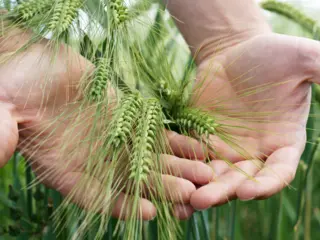
Sulfur is used in agricultural chemistry, among other things as a fungicide against fungal decay in viticulture and tomato cultivation. As a component in fertilizers, it helps in the formation of amino acids and enzymes and thus accelerates plant growth. Particle size plays a decisive role in the absorption of sulfur via the leaf structure.
Initial Situation:
- Crystalline sulfur particles 5 mm - 10 mm
- Coarse suspension tends toward sedimentation
- Clogging of agitator bead mills
Improved production process with the ProPhi:
- Three-stage production process with MaxShear, ProPhi 20 and Alpha® Discus 4
- End fineness achieved after pre-dispersion d95 = 55.5 µm with 4.0 mm grinding beads
- Fine dispersion with Alpha® Discus 4 and 1.0 mm grinding beads; end fineness d95 = 14.4 µm
- Reduction of the total energy consumption by up to 30%
- Reduction of the premix time by 50%
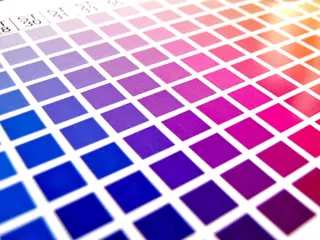
One of the most important process parameters in the fine grinding of printing inks is the grinding bead size. The smaller the beads, the better the coloristic properties such as color intensity, transparency and gloss. In addition, in most cases, smaller grinding beads increase the production capacity or save pigments.
Initial Situation:
- Particle size after pre-dispersion with a dissolver is d95 > 100 µm
- Fine grinding with a pin mill using 1.2mm - 1.4 mm Ø grinding beads
- Production capacity of 75 kg ink/h
- Specific energy requirement for the production line 165 kWh/t
Improved production process with the ProPhi:
- Two-stage pre-dispersion process with Epsilon inline disperser and ProPhi pre-grinding unit
- Use of 2.5 mm - 2.8 mm Ø grinding beads for pre-dispersion
- Flow rate of 7.5 m³/h - 10.0 m³/h
- Ultra-fine grinding with Alpha® Neos agitator bead mill; grinding bead size 0.3 mm Ø
- Increase in the capacity factor by 3.2
- Reduction in the total energy consump-tion of more than 50%
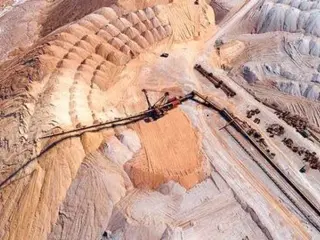
Both natural minerals and the products created through calcination processes usually have very coarse particles. For further processing in aqueous slurries, these must first be pre-ground in a laborious process. Due to their high density, the pre-ground materials settle very easily in pipelines. The suspension only becomes stable below a certain particle size.
Initial Situation:
- Pre-grinding in very large drum mills
- High energy requirement
- Strong sedimentation formation and rigid / slow production flow
- Tendency to clog
Improved production process with the ProPhi:
- Two-stage dispersion process with Epsilon / Ψ-Mix® inline disperser and ProPhi pre-grinding unit
- High flow rate of 15 m³/h, solids content at 65%
- High addition rate of solids
- Easy embedding in automated production line
- Iron-free grinding due to ceramic and PU coating of the process zone
- Stable production process with end fineness d50 = 3.5 µm
- Specific energy 0.05 kWh/kg
- Production capacity 200 kg/h
Videos
Downloads
Your Contact at NETZSCH
Any specific questions? Contact us for help.
you may also be interested in: