Epsilon Inline Disperser
The New Inline Mixing Experience
The unique System for dispersing Solids in Liquids

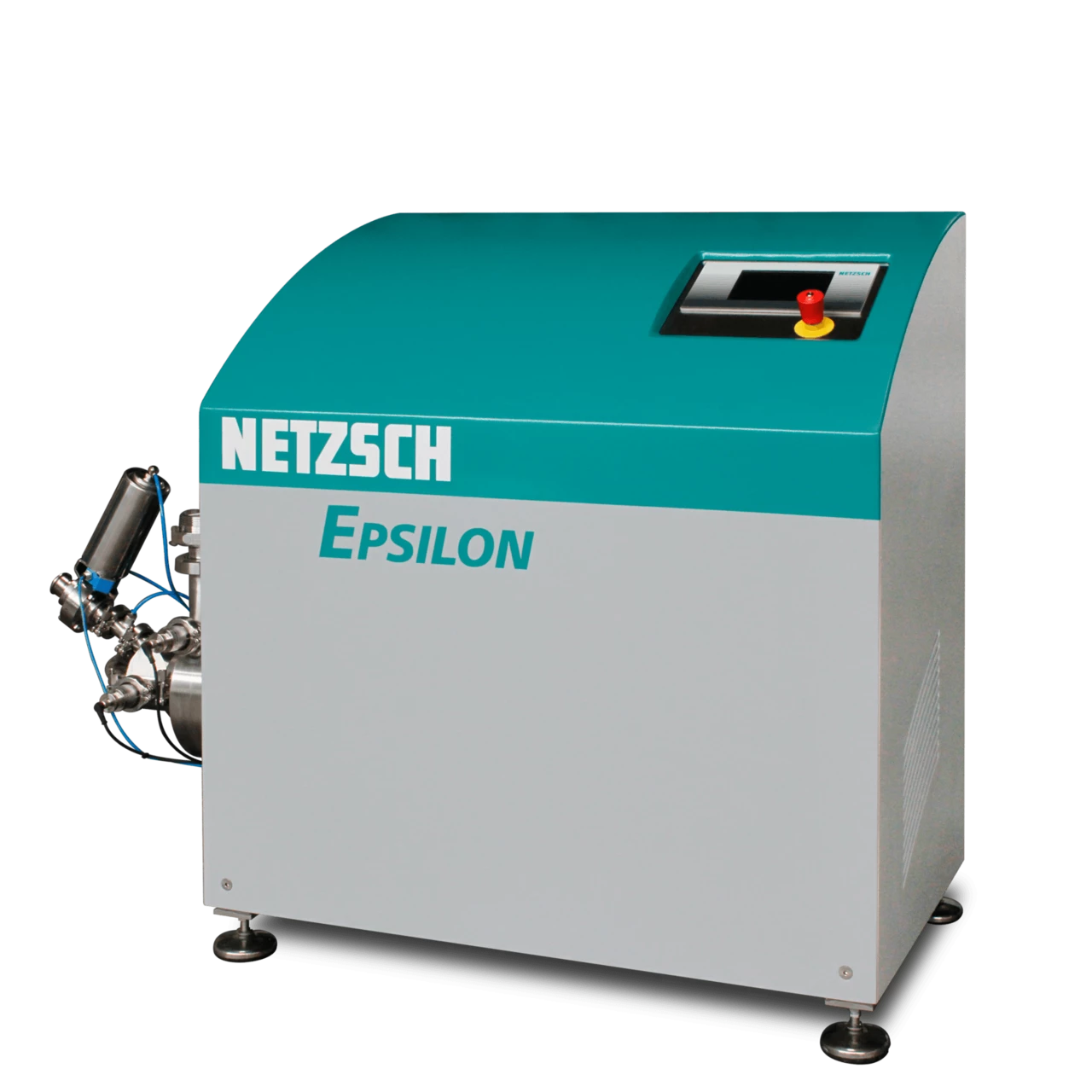
NETZSCH Epsilon
AS STANDARD VERSION
The NETZSCH Epsilon inline disperser is unique on the market. In the standard version, dispersion is not based on the conventional rotor-stator principle, in which high shear forces and a high energy input are used to disperse powder in liquid. In this version, the dispersing principle of the NETZSCH Epsilon does not use a stator through which the product flows and no narrow shear gaps between the rotating and stationary parts.
The pressure differences created by the pumping and centrifugal effect of the rotor are used to achieve the best possible wetting and dispersion of the powdered solids in liquid.
The resulting advantages are:
- Minimal product heating
- Lowest input of shear forces
- Deareation of the product after the solid intake
- Insensitive to small foreign objects
High availability Application Fields:
- Shear-sensitive products
- Temperature-sensitive products

NETZSCH Epsilon
AS A ROTOR-STATOR VERSION
For products that require dispersion with more energy, the NETZSCH Epsilon can also be equipped with a classic rotor-stator version. The dispersion principle is the same as in the standard version. Vacuum expansion of the contained air and wetting by overpressure also takes place here. However, the stator, through which the product flows, introduces significantly higher shear forces into the product.
The result is higher shear forces in the product for deagglomeration of powders that are difficult to disperse.
The Advantages of the Rotor-Stator Version:
- More intensive dispersion of agglomerates that are difficult to disperse
- Shorter dispersion time
Application Fields:
- Solids that are difficult to disperse
- Shear-insensitive products
Experience the advantages of our Epsilon Inline Disperser:
Best wetting of the solid surface
Gentle processing of sensitive formulation components
Quick and easy to clean, good accessibility
No adhesion of powder dust in the process tank
Separate feeding of solid and liquid
Loss-free incorporation of solids
- Automatic mode eliminates operator error
- Tolerant to smaller foreign objects, generally, no machine downtime
- Explosion-proof version

Technique

| Technical Data | Epsilon 30 | Epsilon 90 |
|---|---|---|
| Solids intake [kg/h] | 50 - 5000 | 150 - 12000 |
| Suspension flow during solids intake [m³/h] | 15 - 30 | 40 - 80 |
| Max. suspension flow during circulation [m³/h] | 67 (water) | 130 (water) |
| Drive power [kW] | 30 / 37 | 75 / 90 / 110 |
| Max. speed [1/min] | 3600 | 3600 |
| Max. discharge pressure [bar] | 5 | 5 |
| Min. feed pressure [bar] | 0.1 - 0.5 | 0.1 - 0.5 |
| Version of Execution | Standard Version / Rotor-Stator Version The Epsilon can be converted to the other version in a short time | Standard Version |
Operating Principle
The Epsilon works together with a product tank in circulation. After the machine is started, the liquid flows to the Epsilon and is pumped back into the tank.
Due to the strong pumping action of the rotor, a strong negative pressure is created in the process chamber of the Epsilon. This vacuum is used to draw in the powdered solids. No external vacuum generation or addition of external air is necessary. Powder that has been prepared in a hopper, silo, bag loading station or BigBag station is automatically drawn in by the machine when the powder feed is opened.
After the powder delivery, the powder feed is closed and, if necessary, circulation of the product continues. In this step, the enormous advantages of the dispersing system become clear: the subsequent dispersion improves the quality and simultaneously deaerates the suspension. Due to the low energy input, warming of the product is significantly reduced compared to conventional rotor-stator systems.

- All powders contain air. The amount of air contained in the powder is the ratio of the bulk density to solid density and can be from 75 to more than 90 percent by volume. For a good dispersion result, this air must be completely replaced by liquid and the particles separated.
- During the intake of the powder, the air contained in the powder expands in the negative pressure of the suction area. Loose agglomerates can break up at this point, while stronger agglomerates remain intact.
- In the state of expanded air, the powder is drawn directly into the liquid and surrounded by it.
- As the process continues, the powder enters the outer region of the process chamber in which there is a strong overpressure due to the centrifugal effect of the rotor. Here, the previously expanded air is strongly compressed and the surrounding liquid is forced into the core of the agglomerate structure.
- Agglomerates wetted in this way can be dispersed with considerably less energy input. The desired fineness is achieved through subsequent dispersion, in which the product repeatedly passes through the negative pressure and overpressure region and is exposed to strong turbulence and micro-cavitation. The product is also automatically deaerated during subsequent dispersion. Air is drawn from the product in the negative pressure area and returned as large air bubbles to the tank, where they easily rise and outgas. Due to the gentle operation, significantly less energy is applied, in contrast to shear-based systems, so that even low temperature limits can be easily maintained.
NETZSCH Plant Construction

Process Technology and Plant Construction
- Turnkey plant design, plant expansion and modernization using the latest machine and process technology.
- Project management from start to finish with performance guarantee.
- Worldwide customer service for spare parts, training, service and plant maintenance, etc.
System Integration
- Installation and operation on one level
- Compact dimensions
- Continuous batch production through, for example, combination with two or more process tanks and agitator bead mills
- Connection for drawing in small quantities of liquid
- Residue drainage
- All optional connections can be operated manually or automatically
- Explosion-proof models for gas, dust and conductive dusts
- Integration into the customer‘s process control system
- Individual programming and process integration possible
- Remote maintenance service
- Noise protection enclosure





Videos
Your Contact at NETZSCH
Any specific questions? Contact us for help.
you may also be interested in: