Introduction
Lactose (milk sugar) is a crystalline, colorless substance with a sweet taste that is used in many ways, especially in the food and pharmaceutical industries.
As a pharmaceutical excipient, for example, it serves as a filler, coating or active ingredient carrier in the production of sprays or tablets. In processed foods, lactose is often used as a carrier for flavors due to its functional properties or is added to increase texture due to its good water-binding capacity. Nutritionally, it is also an important ingredient in infant formula.
For a wide variety of applications, defined particle size spectra of the lactose powder are required, which can be produced by means of special grinding processes. Two technologies are mainly used here: high density bed jet mills are used for the production of ultrafine powders (approx. 95 % < 3 - 30 µm), while impact mills with classifiers are used for coarser finenesses (approx. 95 % < 30 - 80 µm).
Production of ultrafine lactose
For the production of powder mixtures for infant nutrition, very fine lactose is added as a high-quality nutrient. Even finer powders are used, for example, in powder inhalers, where finenesses < 10 µm are required.
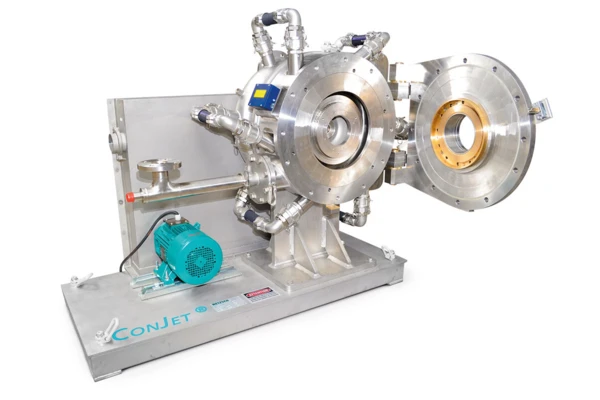
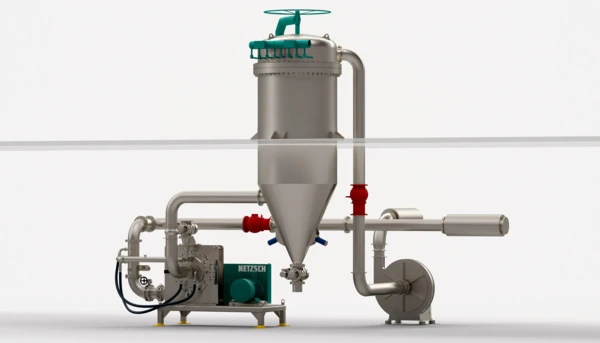
For both applications, the NETZSCH ConJet® high density bed jet mill is the suitable solution. Through the combination of a spiral jet mill and an integrated classifier wheel, this type of machine enables the end product to be manufactured reproducibly and with a steep particle size distribution. The adjustment of the fineness is independent of the product load and is only done by the speed setting of the classifier wheel. This allows the mill to be operated much more economically with higher product loading. Due to the high energy density thanks to the rotating product bed, the efficiency can be improved by up to 40% compared to conventional jet mills.
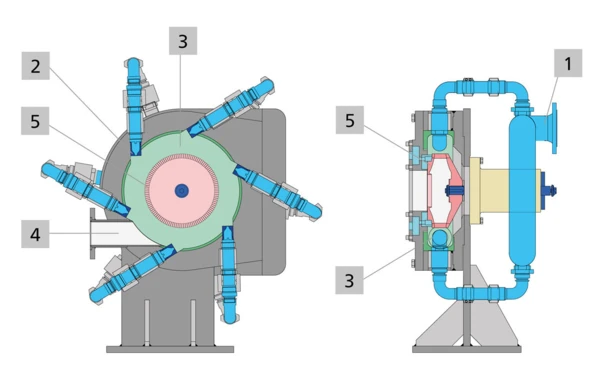
In the ConJet® high density bed jet mill, the grinding gas is supplied through the annular grinding gas distributor (1) and and the nozzles (2) into the grinding chamber (3) and expanded. During this process, high velocity jets are formed which capture and accelerate the material to be ground, which is introduced tangentially into the grinding chamber by means of an injector or gravimetrically via a valve through a short feed pipe (4). The product is comminuted by particle-particle impacts. The expanded gas transports the ground particles to the classifier wheel (5), which is driven via a speed adjustable motor. The fines are discharged from the mill together with the expanded gas. Oversized particles return to the grinding chamber to be stressed again. Thus, the high density bed jet mill achieves the highest finenesses with exact and reproducible control of the particle size and splash-free limitation of the oversize particle.
Another advantage compared to a conventional jet mill is that no minimum amount of product is required to carry out the grinding process. This means completely ground batches and maximum product yields, as almost no residual material remains in the mill after one pass. Furthermore, the compact design of the mill ensures very good accessibility for easiest and quickest cleaning during product changes.
The residue-free grinding of product within the machine makes the ConJet® the ideal mill for grinding lactose in the ultrafine range. The ConJet® high density bed jet mill is available in different sizes on a laboratory scale in sizes ConJet® 10 and 16, and on a production scale in sizes ConJet® 32 to 71.
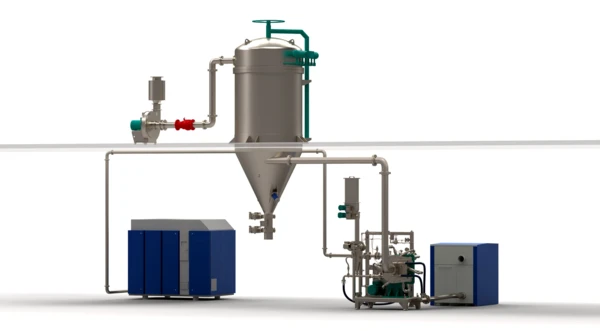
Production of lactose powder with the fine impact mill Condux® with Classifier
A newly designed version is the Condux® with integrated, dynamic air classifier (Fig. 4). This is used when the desired final fineness is not achieved with conventional sieve-less pin mills or blower mills with sieve insert – for example for the production of lactose powder with finenesses of 95 % < 75 µm.
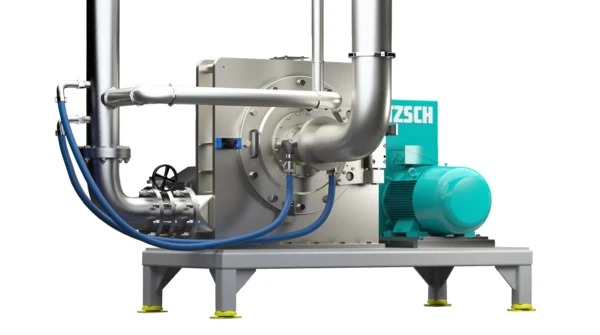
In contrast to conventional classifier mills, the grinding disk and classifier wheel are non-rotatably connected to each other and are operated by a common drive motor. This considerably reduces the investment costs of the plant and enables economical ultra-fine grinding. With the adjustment of the classifier wheel height, it is possible to achieve a variable setting of the separation limit in the simplest way with exact upper particle size limitation. In addition, thanks to the swing-open housing door, quick and easy access for cleaning and maintenance is ensured, just as with the high density bed jet mill. For the food industry, the machine is produced as standard in stainless steel 314 or 316, with a surface quality Ra < 0.8 µm.
Summary
In the food industry, ever-increasing demands are being placed not only on product quality, but also on the performance and hygienic design of production equipment. Here, NETZSCH offers tailor-made, process engineering solutions for the size reduction step for different requirements. As a member of the EHEDG, NETZSCH contributes to ensuring safe food production in all areas of the food industry with the hygienic construction and design of its machines and systems.
Part of NETZSCH's comprehensive service program is the well-equipped technical center for food applications, the FoodLab at the Hanau site. There, tests can be carried out under food-compliant conditions on both the ConJet® dense bed jet mill and the Condux® impact mill.