Introduction
In 2017 the world population was estimated at 7.5 billion people. By 2030 it is expected to reach between 8.5 and 8.9 billion (Source: UNO demographic Data Base). We are facing a huge change. Most probably the biggest challenge for scientists and farmers in the future is to find ways to feed so many people. There are several means of increasing the world agricultural production. Increasing the amount of arable land is one of them and this is already a major topic of public discussion. The enhancement of agricultural productivity by using fertilizer or by protecting crops is another method of equal importance.
In this article, we will concentrate on this last point: the production of plant protectives and more particularly the important step in their production process which is the milling.
State of the art
Manufacturing process
The producers of pesticides develop specific compositions or formulations in such a way that the active molecules have an effect on the right target (insect, weed or fungus…) with the right intensity, at the right moment when the crop needs to be protected. The plant protectives are therefore a mixture of different components. Basically, we can split them into 3 categories:
- The active ingredients of which there can be one or several in the same formula.
- The dry fillers such as clay, talc, kaolin or silica for dilution of the active material.
- Adjuvants and additives giving certain qualities (stabilizing agent, wetting agent, repellent, anti-foaming…)
In this respect, the process for production of pesticides starts with dosing of the ingredients and intensive mixing. The different mills which are presented below are required at the next stage. The aim is to obtain homogeneous sizing of all the different particles coming from the different ingredients and to obtain an end fineness compatible with the final application. After milling, safety sieving eliminates possible oversized particles, a second mixing step will re-homogenize the product and mix the added ingredients which do not need to be ground.
At the end of the production line, we obtain the final products: Wettable Powders (WP) are produced ready for packing. If a supplementary stage of pelleting or granulation is added, the end product obtained is then called Water-Dispersible Granules (WG).
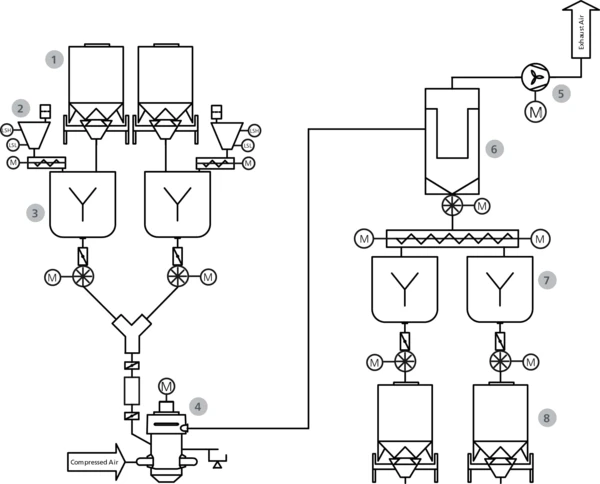
Reasons for fine grinding of pesticides with sharp top cut of the Particle Size Distribution
A finer powder contributes to making the action of the pesticides more efficient on targets. Therefore, for the same result after treatment, it is possible to use a lower number of active ingredients in the formula.
This is beneficial for safety, environmental and economic reasons.
- Less toxic product for the farmer and neighbor in the spreading zone.
- Lower amount of pollution in the environment after treatment.
- As active molecules are the most expensive component, increased profit for the pesticide producer.
Pesticide powders without oversized particles simplify the end application on the crop by the farmer:
- Before application on the crop, the powder is dispersed in water. If particles are finer, the suspension is more stable and sedimentation does not occur during operation.
- Spreading on crops is carried out by a spraying system with a series of nozzles. Clogging of nozzles by oversized particles does not allow a regular spraying and can even make it impossible.

The solution from NETZSCH
Based on fineness and specification requested by the producers of plant protectives, NETZSCH has developed and made available different technologies of dry milling. The choice of the right mill must be done carefully.
Condux® mechanical Impact Mills
These rotary impact mills are used for fine grinding soft and medium hard materials. The typical fineness range for the median particle size is between 20 and 500 µm. Circumferential speeds of between 25 and 150 m/s are achieved. A version is also offered in counter-rotating operation up to 250 m/s. The air flow, which depends on the type of rotor, ensures temperature-stable grinding. The rotor is mounted on a horizontal fly shaft arrangement. Sealing of the shaft is based on the high circumferential speeds at the shaft with contact-free labyrinths.
Mechanical impact mills can be equipped with a range of different grinding tools. This allows them to carry out 2 different tasks on plant protectives:
With blast rotor combined with stator (screen or grinding track), the Condux® mill proceeds pre-milling. These grinding tools produce a blowing effect with high air flow and lowest possible temperature increase. The efficiency of the thermo-sensitive active ingredient is thus maintained. The lowest possible fineness which can be reached with this combination is down to < 100 µm.
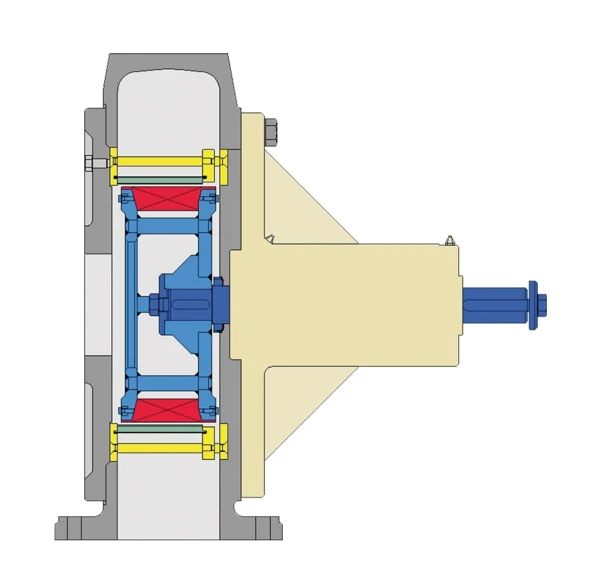
With grinding disc and integrated dynamic air classifier, Condux® mills produce the standard fineness requested for pesticides which is around < 30 µm. In this case the design of the machine stays simple with only one drive for grinding disc and classifier wheel. The top cut is defined by adjusting the height of the classifier wheel, and the accessibility to the grinding chamber is very easy for quicker cleaning between 2 different products.
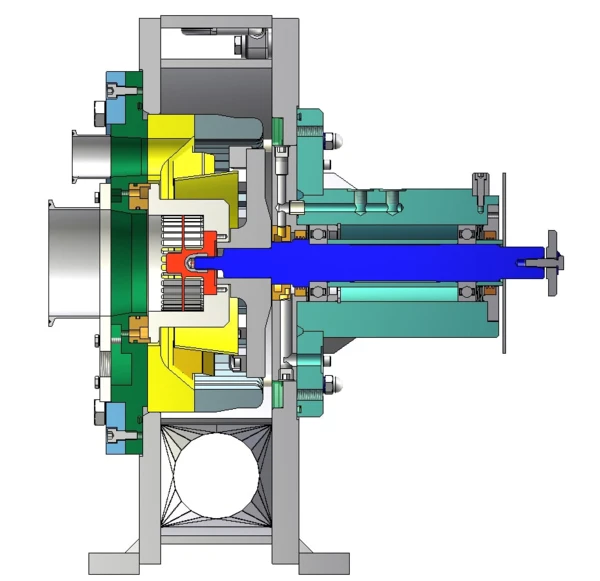
Mechanical Impact Classifier Mills type CSM
This so-called classifier mill offers the possibility of having milling and classifying effects in one system. The CSM classifier mill is a combination of fine impact mill and deflector wheel classifier. With 2 independent drives, one for the grinding disc and another for the classifying wheel, the CSM can be adjusted with accuracy and gives a large range of end-product fineness, from d97 = 9 µm to 200 µm (see Table 1). The geometry of the classifier wheel, as well as the air purge gap between rotary classifier wheel and stationary mill cover, give a high precision top cut with a milled product free of oversized particles.
Table 1: Reference data for Classifier Mill
| Product | Machine | Fineness [µm] | Capacity [kg/h] |
| Fungicides and Pesticides | CSM 360 | d99 = 45 | around 400 |
| Sulphur | CSM 165 | d99.9 = 63 | around 200 |
Fluidized Bed Jet Mills type CGS
This air jet mill is used for ultra-fine grinding soft to extremely hard materials in a fluidized bed. Grinding takes place in the air jet without tools, a dynamic classifier limits the maximum particle size. The fine milling of the particles is obtained due to the high velocity of the air jets at the outlet of the nozzles inside the grinding chamber: 500 to 600 m/s. The high level of available energy and the speed of the impact between particles in the fluidized bed makes it possible to achieve a d50 fineness of 1 to 5 µm (see Table 2).
Table 2: Reference data for Fluidized Bed Jet Mill CGS:
| Product | Machine | Fineness d50 [µm] | Fineness d99 [µm] | Capacity [kg/h] |
| Pesticides | CGS 71 | 5.5 | 23 | around 620 |
| Herbicides | CGS 50 | 2.7 | 18 | around 248 |
| Fungicides | CGS 16 | 2.2 | 18 | around 6.5 |
A very interesting point for plant protective applications is that the energy received by the product for breaking the particles does not generate any heat. The expansion of the air physically induces a decrease of its temperature. Therefore, despite the creation of heat when the particles impact each other and break, the 2 phenomena are balanced, and the temperature stays constant. In this way, the active molecules are not damaged.
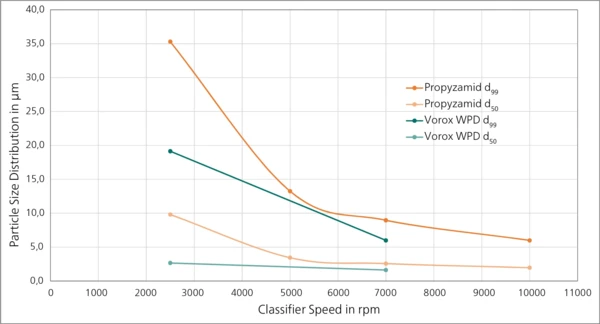
Classifying takes place in the top part of the CGS mill, in a quiet zone well separated from the milling zone. The specific design of the Convor wheel makes it possible to achieve a sharp top cut even at a few microns. The easy control of the rotating speed by a frequency converter gives the mill type CGS a wide range of possible finenesses (see Figure 5).
Whatever the selected milling technology, attention should also be paid to the design of the complete grinding plant. Below we explain 2 important aspects which must be considered: Safety in front of the dust explosion risk and cleaning for limitation of contamination.
Dust explosion protection of the milling plant
In most cases. pesticides include organic components which present dust explosion risks. The characterization of the complete formula by a certified laboratory will define the applicable values for dust explosion. This mainly concerns the minimum ignition energy, the ignition temperature and the KSt value. Depending on this data and when the limits are exceeded, the milling installation must be equipped with adequate protection. A solution with pressure shock design of the plant including specific elements such as explosion valves and rupture discs has the advantage that it limits production costs and keeps operation simple. A second solution is to grind under inert gas with control of the oxygen content in the plant. An explosion suppression system using fire extinguishing powder sprayed into the installation is the third solution.
Easy cleaning design of the machines and of the complete plant
Very often, the same plant is used for several products with completely different formulas and possibly antagonist active ingredients. In such cases, producers of pesticides must take particular care with the cleaning of their milling plants between 2 campaigns.
As a manufacturer of machinery, NETZSCH has worked intensively on the design of their grinding plants. User-friendly accessibility of the internal parts is achieved with a cover which opens completely including the classifier wheel, with a swiveling housing of the mill and well-positioned doors. Washing with water is made possible and is easy because of the stainless-steel construction, fine polishing and bottom discharge valve on the mill.
Summary
Currently the production of plant protectives is gaining in strategic importance. It must be reevaluated to put more emphasis on environmental restrictions, in both production in the chemical process and in agriculture when spreading on crops. However, the challenge to feed the world´s population continues to be an issue. The role of the chemical industry is to produce plant protectives in the best way. The selection of the most suitably adapted milling technology contributes to this.
Condux® mechanical impact mills are well adapted for relatively coarse milling and for pre-grinding. Equipped with a classifier, this machine is still simply designed and fulfils the standard specification of the final product. For optimal top cut without oversized particle, the classifier mill type CSM is recommended. For production of high-quality pesticides, the fluidized bed jet mill type CGS brings key advantages, namely higher fineness, a final product free of oversized particles and the best preservation of the active ingredients. Whatever the selected technology, the design of the plant must meet the specific restrictions of the application which are mainly dust explosion risks and contamination.