Introduction
India together with China, are and will continue to be the growth motors of the global pigment industry. This is the conclusion of a study by the market research department of JM Financial in 2020. India is also substantially increasing domestic demand and export volume. With a GDP growth rate of 11% forecast for the next 5 years, manufacturers are focusing on meeting the expectations of end users who are constantly moving in line with fashion trends. Moreover, their challenge is heightened due to the critical flow behavior of their powders all along the production process. Here we would like to present a series of milling processes which present suitable and cost-effective solutions for fine grinding of a wide variety of dry pigments used in the industry.
Why milling has an important role for the quality of pigments:
Pigments are present in many applications. They are used for coloring other materials such as paint, ink, plastic, fabric, cosmetics and even food. On one hand we have dry insoluble pigments, and on the other we have dyes in the form of a liquid or soluble compound. As a result of this dry form, the intensity and coloring of pigments are strongly influenced by the fineness and the shape of their particles. A more efficient milling can thus result in more intense pigment by improving the dispersion of the pigment in the colored material. In addition to this, the specific size and shape of particles give a particular appearance to the surface. The absorption and the refraction of light are modified which in turn, affects the coloration.
Criteria which must be taken into consideration when choosing grinding technology:
As already mentioned, a wide variety of pigments with very different origins exists. The oldest ones are natural pigments such as natural ultramarine made from minerals and carmine made from insects. Today, most pigments used are of synthetic origin. Examples of organic pigments are phthalocyanine or quinacridone and examples of inorganic pigments are chrome oxide or iron oxide.
Depending on the origin, it is obvious that each of these pigments is the results of a particular process with specific production steps such as purification, synthesis, oxidation, calcination, precipitation etc. Thus, to define the grinding operation which should be take place subsequently, we must always take the behavior and the properties of the product resulting from this process into account. One possibility is that the pigment already presents very fine elementary particles and the only subsequent process necessary is deagglomeration. In this case, the grinding technology to be used should not comprise high impact speed. The opposite is also the case for pigments for enamel. These materials can have a hardness of up to 9 Mohs and only jet milling can be used.
For all these reasons, one needs to know the characteristics of the pigment before the most appropriate grinding technology can be selected.
Condux® mechanical Fine Impact Mills
Rotary impact mills are used for fine grinding soft and medium hard materials. The typical fineness area for the median particle size is between 20 and 500 µm. Circumferential speeds of between 25 and 150 m/s are achieved. A version can also be offered in counter rotating operation with up to 250 m/s. The air flow, which depends on the type of rotor, ensures temperature-stable grinding.
The rotor is mounted on a horizontal fly shaft arrangement. Sealing of the shaft is based on the high circumferential speeds at the shaft with contact-free labyrinths. The product is centrally fed through the door and leaves the machine with the air, which at the same time carries out transport and cooling tasks.
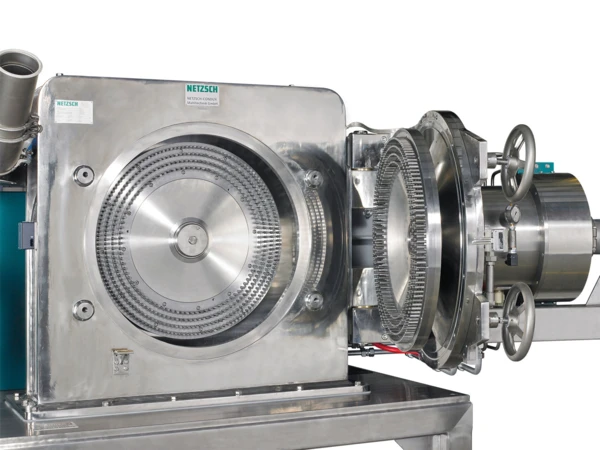
The characteristics of these mills makes them perfectly adapted to pigments, for which deagglomeration is needed, for instance after a drying step. In addition, easy access after opening the front door allows cleaning in a short time when the color is changed. Moreover, the large range of grinding tools which can be mounted in Condux® mills means they can be used for processing various products and to give different finenesses.
Table 1: Reference Data on Condux® 300
| Product | Fineness [µm] | Fineness [µm] | Capacity [kg/h] |
| Ultramarine blue | d50 = 1.85 | d99 = 3.1 | Around 200(*) |
| Tartrazine red | d50 = 9.4 | d99 = 23 | Around 89(*) |
| Organic pigment blue | 24% > 63 | 2% > 250 | 600 |
| Pigment preparation base PVB | d50 = 99 | d90 = 255 | 340 |
| Zinc Oxide | d50 = 6.4 | d90 = 14 | 1490 |
(*) Pin disc counter rotating design
ConJet® High Density Bed Jet Mills
ConJet® mills are spiral jet mills equipped with a dynamic classifier wheel creating a high-density bed of material inside the grinding chamber. They are used for the size reduction of soft to hardest materials. The grinding gas is supplied through the annular grinding gas distributor. The gas enters the grinding chamber through nozzles, expands and forms jets at high velocity. The material to be ground enters the grinding chamber by means of an injector or gravimetrically via a valve, tangentially through a short feed pipe, is picked up by the gas jet, accelerated and comminuted by particle-particle impacts. The expanded gas transports the ground particles to the classifier wheel which is driven via an adjustable motor. The fine material corresponding to the set parameters is discharged from the mill with the expanded gas. Oversized particles return to the jet area for regrinding.
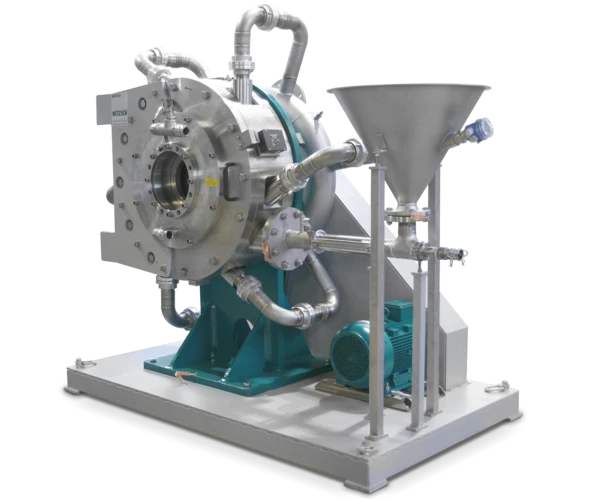
This operating principle of the ConJet® is particularly suitable for pigment production. The high impact speed gives a high fineness e.g. d99 = 5-7 µm when grinding mineral pigments. The classifier mill perfectly controls the particle size distribution which is adjustable, narrow and free from over-sized particles. In addition, the free access through a front door mounted on hinges means the cleaning operation on the ConJet®, is easy and quick.
Table 2: Reference data for ConJet® 50
| Product | Fineness d50 [µm] | Fineness [µm] | Capacity [kg/h] |
| Organic pigment yellow | 1.5 | d99 = 6.6 | around 134 |
| Organic pigment magenta | 3.2 | d99 = 9.8 | 81 |
| Organic pigment red | 1.5 | d99 = 5.5 | 193 |
| Organic pigment fluorescent | 3.3 | d99 = 9.1 | 104 |
| Synthetic Iron Oxide | 0.94 | d99 = 5.9 | 92 |
| Titanium Dioxide | 0.9 | d97 = 2.8 | 103 |
| Titanium Dioxide | 2.2 | d97 = 6.5 | 243 |
s-Jet® Steam Jet Mills
The s-Jet® is a jet-milling system, which has the advantages of dry-grinding with superheated steam. It is used for ultra-fine grinding soft to extremely hard materials in a fluidized bed. By using an air classifier integrated in the mill the maximum particle size is limited and it is possible to achieve a submicron range fineness.
Significant benefits are gained by using superheated steam as a grinding medium instead of air. The jet energy which is considerably higher compared to that of air (jet speeds of up to 1200 m/s can be achieved) increases the discrete energy input, and the kinetic impact energy of the product particles is increased fourfold. This is the most decisive point for obtaining finenesses in the submicron range. In addition to this, as steam has a considerably higher sound velocity than air, the possible peripheral flow speed within the classifier wheel also increases and with this the acceleration forces which effect the product being classified.
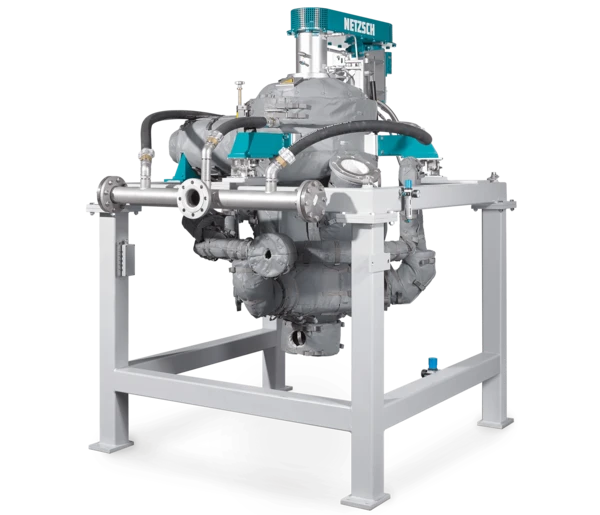
Due to the high steam temperature of over 300°C and due to the increase of the particle surface in the grinding process, the moisture contained in the particles is evaporated. Furthermore, s-Jet® mills offer the possibility of drying or at least finishing the drying operation of the pigments. In this way the s-Jet® process allows full use of the energy from pressure and temperature by simultaneously milling at finest grades and achieving residual moisture contents of as low as 0.5 %.
Table 3: Reference data on s-Jet® 500
| Product | Fineness d50 [µm] | Fineness d99 [µm] | Capacity [kg/h] |
| Synthetic Iron Oxide | 0.07 | 0.37 | 61 |
| Carbon black | 0.6 | 3.6 | 28 |
| Carbon black | 1.0 | 9.2 | 94 |
| Zinc Oxide | 0.13 | 0.35 | 6.1 |
| Zinc Oxide | 0.87 | 4.8 | 183 |
| Titanium Dioxide | 0.13 | 0.34 | 191 |
| Ceramic pigments | 0.6 | 1.95 | 26 |
| Ceramic pigments | 0.9 | 4.6 | 102 |
Dust explosion protection
If the product being ground is an organic pigment, the characteristic values applicable for dust explosion require special attention. This mainly concerns the minimum ignition energy, the ignition temperature and the Kst value. Depending on this data and when the limits are exceeded, adequate protection must be in place. The first solution is a pressure shock resistant construction of the plant including specific elements such as explosion valves and rupture discs. A second solution is to operate under inert gas with reliable control of the oxygen content in the plant.
Summary
In view of the fact that a wide variety of pigments are available and that the first steps in their production process give them variable qualities, it is important to select and to optimize the most suitable milling technology. Condux® mechanical Impact Mills are well adapted for relatively coarse milling and for deagglomeration. ConJet® High Density Bed Jet mills can deliver to finer products with an optimally controlled PSD. The s-Jet® Steam Jet Mills reach their highest level of performance in terms of fineness while additionally offering a drying effect. Using the most appropriate technology makes it possible to handle pigments which often have critical flow characteristics, and to achieve the requested fineness and quality of the final product. This optimization of the milling process also adds value to the product and saves energy and other production costs.