Introduction
Mechanochemical activation (MCA) is a rapidly growing technology in many areas of materials science, particularly in construction. It is based on the application of mechanical and chemical processes to modify materials. One of the main applications of MCA is the activation of additives in cement, known as supplementary cementitious materials (SCMs). These materials include fly ash, granulated blast furnace slag, natural pozzolans, and various clays, which can replace part of the Portland cement and thus the clinker content in cement. This achieves a significant reduction in CO2 emissions during cement production.
Background on SCMs and their Importance
The conventional production of Portland cement consumes a lot of energy and releases large amounts of carbon dioxide. Primary or Scope 1 emissions, amounting to approximately 500 kg of CO2 per ton of cement, are generated during the burning of clinker through the decomposition of CaCO3 into CaO and CO2 and the combustion of fossil or alter-native fuels required for this process. Scope 1 emissions account for approximately 85% - 90% of the total CO2 footprint of cement. Minimizing the clinker content in cement and concrete mixes using SCMs offers significant potential for reducing these emissions. In addition, SCMs can have a positive impact on the long-term strength, water demand, chemical resistance, and workability of cement.
SCMs such as fly ash, granulated blast furnace slag, and silica fume are by-products of other industries and therefore contribute to waste recycling. Although these materials have inherent pozzolanic properties that qualify them for use in concrete mixes, their reactivity is significantly enhanced by mechanochemical activation. In addition, materials such as clays, which have little or no pozzolanic properties by nature, can also be made usable by MCA. When activating clays, waste materials from existing pits or low-grade clays from the clay and ceramics industry can also be mechanically activated, thus offering a similar resource-efficient production of SCMs as the by-products mentioned above.
Fundamentals of Mechanochemical Activation
Mechanochemical activation means that mechanical energy, in the form of grinding or deformation, is applied to a material and this energy initiates or accelerates chemical reactions. When SCMs are mechanically treated, the material is crushed by an intensive grinding process, and its surface area increases dramatically. The increased surface area allows chemical reactions to proceed more quickly and efficiently.
In addition to increasing the surface area, the process of mechanochemical activation also leads to changes in the crystalline structure of the material. This means that crystalline structures are broken down and amorphous, reactive phases are created, which form additional C-S-H and C-A-H phases with the portlandite produced during the hydration of the cement. This secondary C-S-H formation can lead to higher strengths due to higher density. This applies, among other things, to materials such as fly ash, which contain few reactive phases and whose reactivity is dramatically improved by mechano-chemical activation.
Activation Mechanisms
Mechanochemical activation follows several basic mechanisms:
- Specific Surface Enlargement: Grinding signifi-cantly increases the surface area of the material, making more reaction sites available.
- Defect Formation: Mechanical stress leads to lattice defects and fractures in the crystal lattice, making them more chemically reactive.
- Phase Transformation: Mechanical energy can transform stable crystalline phases into amorphous, higher-energy phases that are more chemically reactive.
- Increased Solubility: Mechanochemical activation also increases the solubility of the materials in the cement matrix, which enables the additional formation of the C-S-H and C-A-H phases and supports the hardening of the cement.
Applications and Benefits of Mechanochemical Activation
The application of mechanochemical activation to SCMs offers many significant advantages:
Improved Reactivity
Reduction in Cement Content
Sustainability
Cost Savings
Energy Source
Process Flexibility
Challenges and Future Developments
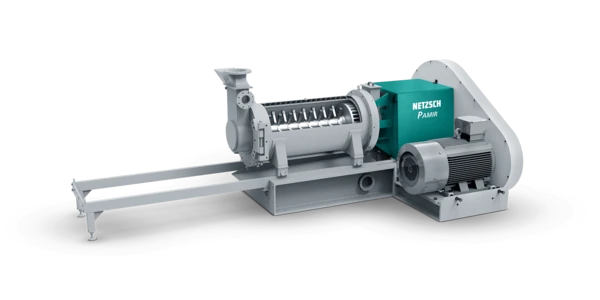
Despite the promising advantages of mechanochemical activation, there are also challenges that need to be overcome. Previous activation studies were often carried out in vibratory or planetary mills. The process parameters and working principles of these laboratory machines are generally not trans-ferable to industrial plants. Activation in a dry agitator ball mill has proven to be an excellent alternative. With the Pamir series, NETZSCH offers a dry agitator ball mill that can perform both grinding and activation of various SCMs and is available in a wide range of sizes from laboratory to industrial production machines.
For the marketing of a complete industrial plant, there are strong partnerships with thyssenkrupp Polysius GmbH in Beckum, Germany, and with Minerva Engineering Inc. in Turkey. As a reliable partner for the planning, installation, and commis-sioning of complete process groups, Polysius or Minerva performs these tasks in close cooperation with NETZSCH.
Conclusion
Mechanochemical activation is a promising method for improving the reactivity of SCMs and offers a sustainable and economical way to revolutionize cement production in the future. It contributes to the reduction of CO2 emissions in the cement industry and opens new possibilities for the use of industrial by-products in the construction industry. Through further research and technological innovation, mechanochemical activation can become an integral part of modern cement and concrete production.