Indroduction and state of the art
The mixing process is the first step in producing Lithium-Ion Battery-Slurries. It is crucial for battery quality and has a significant impact on the cell's performance. In the mixing process, active material, binder, and conductive additives are mixed with a dispersion agent, like water or solvent, to form the battery-slurry.
The mixing tools must distribute the particles homogeneously throughout the entire volume. They use similar geometries for mixing battery slurries like for all other applications, breaking up potential agglomerates, wetting out and coating of particles, and avoiding local material accumulation on a microscopic level.
Currently, many conventional planetary mixers are used for mixing battery slurries for cathodes and anodes.They use similar geometries for mixing battery slurries like for all other applications, and there is almost no significant difference in the design of these machines.
But is the execution of these mixers the best and most efficient method for mixing battery masses?
The Solution from NETZSCH
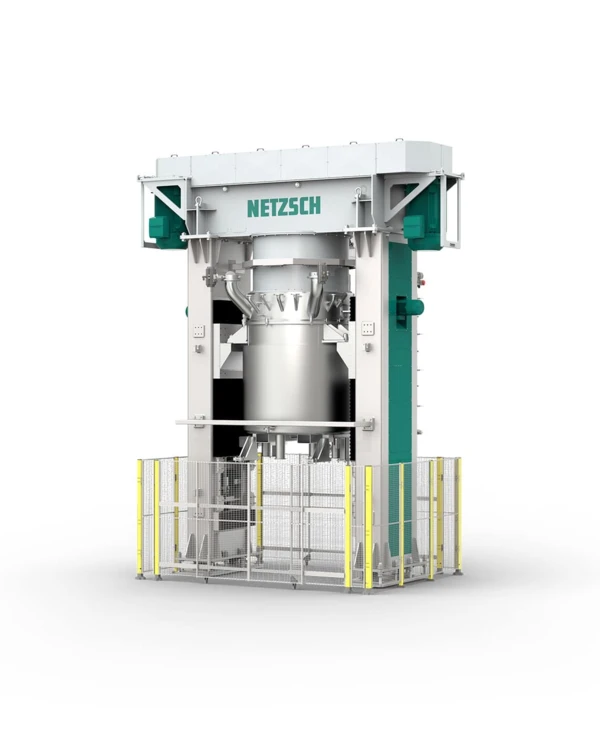
At NETZSCH, we believe there is a better way. With decades of experience in mixing and dispersing technology, NETZSCH has developed advanced solutions specifically designed to meet the challenges of battery slurry production. Our PMH system, for example, significantly reduces process time and improves slurry homogeneity – leading to enhanced battery performance.
Thanks to its optimized mixing design, the NETZSCH PMH ensures highly efficient energy input, gentle but thorough dispersion of sensitive materials, and excellent scalability from lab to production. This makes it a future-ready choice for manufacturers aiming for maximum quality, process reliability, and cost-effectiveness in lithium-ion battery production.
Your Benefits
Reduce Factory Footprint by Factor 1/4
50% Reduction of Specific Energy input
Reduction of Production Times by 200% - 300%
Gentle Mixing - No Damage of Materials
Battery Cell Performance increased by 7%
Production Capacity of Slurry: v = 1 500 l/h per Mixer
Scalable from 1l
to 4 000l
Footprint
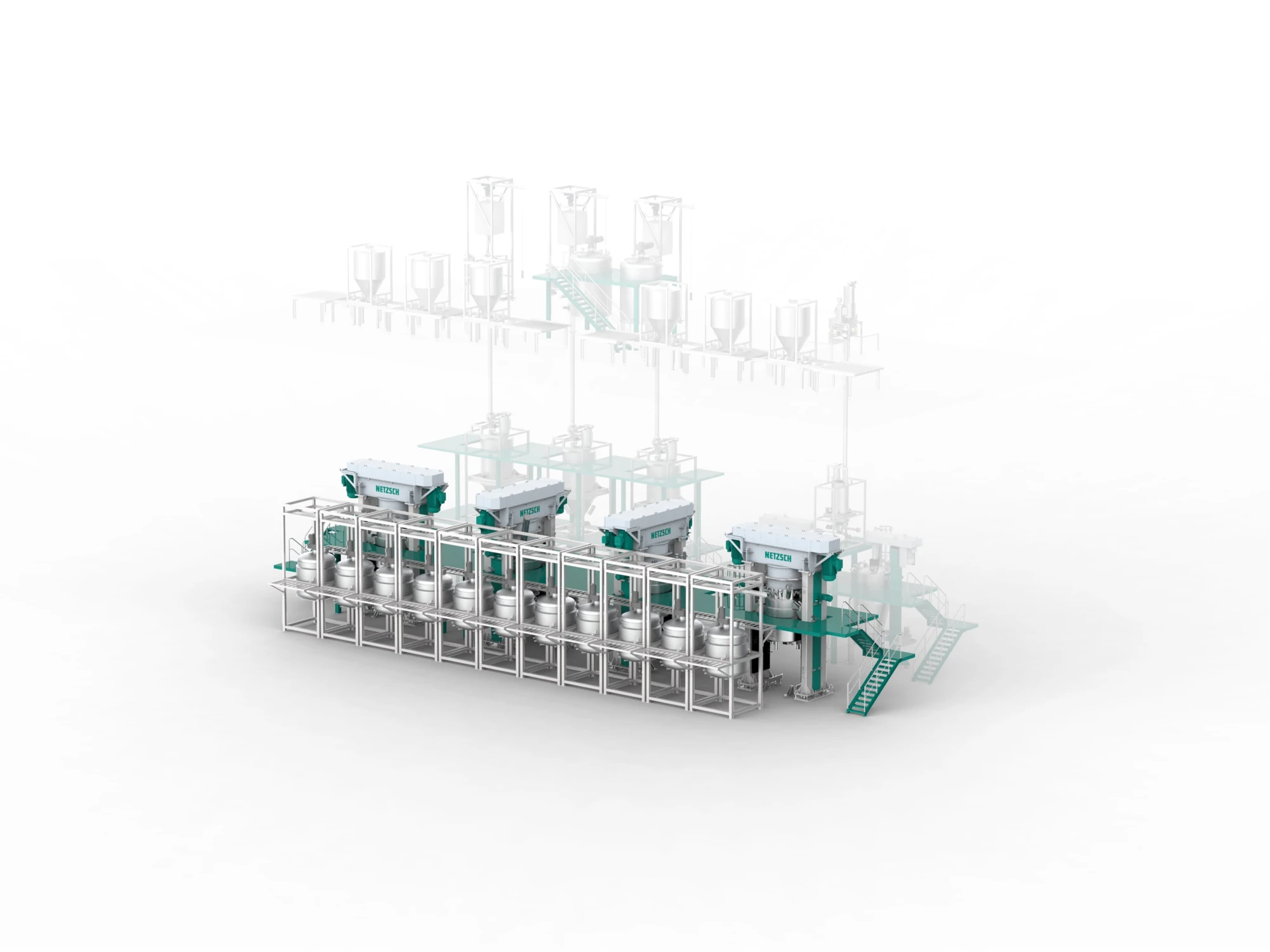
Beyond the fast mixing time and superior dispersion of the slurry, NETZSCH manufacture the largest planetary mixer on the market, the PMH 4000.
The state-of-the-art size of a conventional planetary mixer is approximately 2 300 l (1 600 l usable volume), but NETZSCH has nearly doubled this to a mixer with a volume of ~ 4 200 l. With a usable volume of about 75%, this translates to batch sizes of over ~ 3 350 l. The main costs of a mixing plant are powder dosing and workforce.
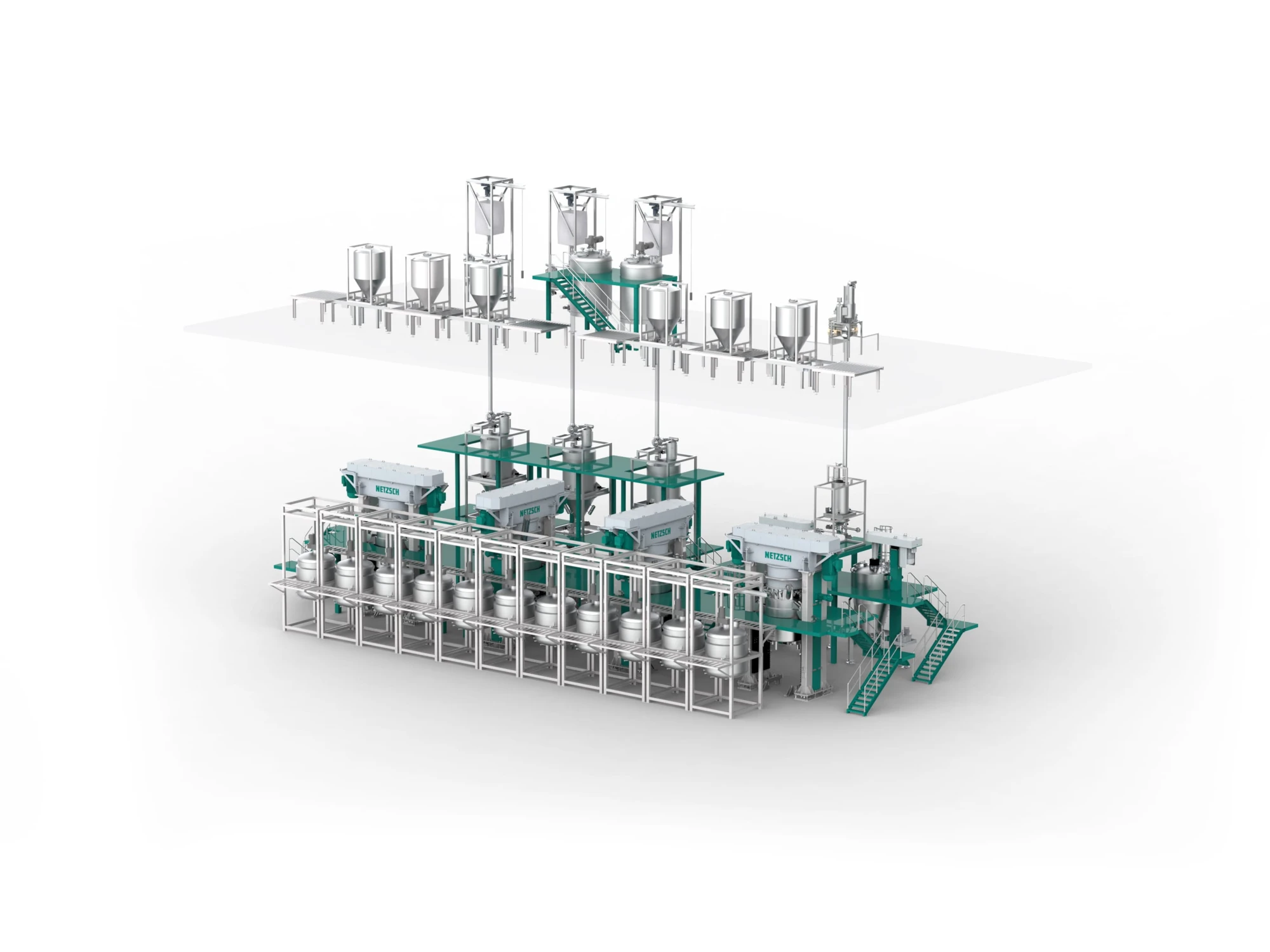
The advantages of the NETZSCH mixing plant include the reduced number of machines required due to faster mixing times and larger batch sizes. Previously, the customer needed about 24 planetary mixers per anode or 12 per cathode line to mix slurries for a Gigafactory producing 20 GWh per year. With the PMH 4000, only 6 mixers for anodes and 3 mixers for the cathode are required, thanks to the reduced mixing time and larger batch sizes.
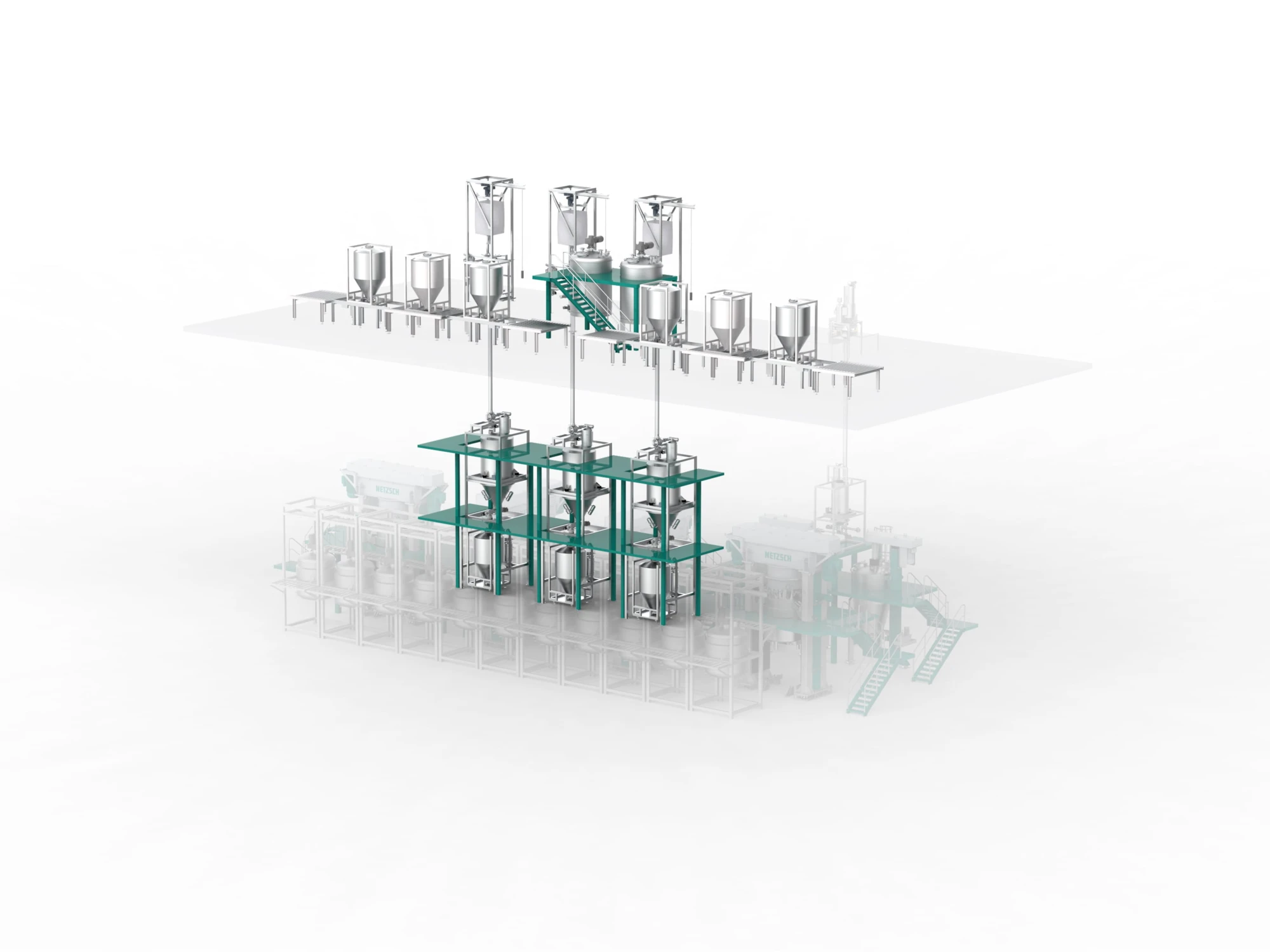
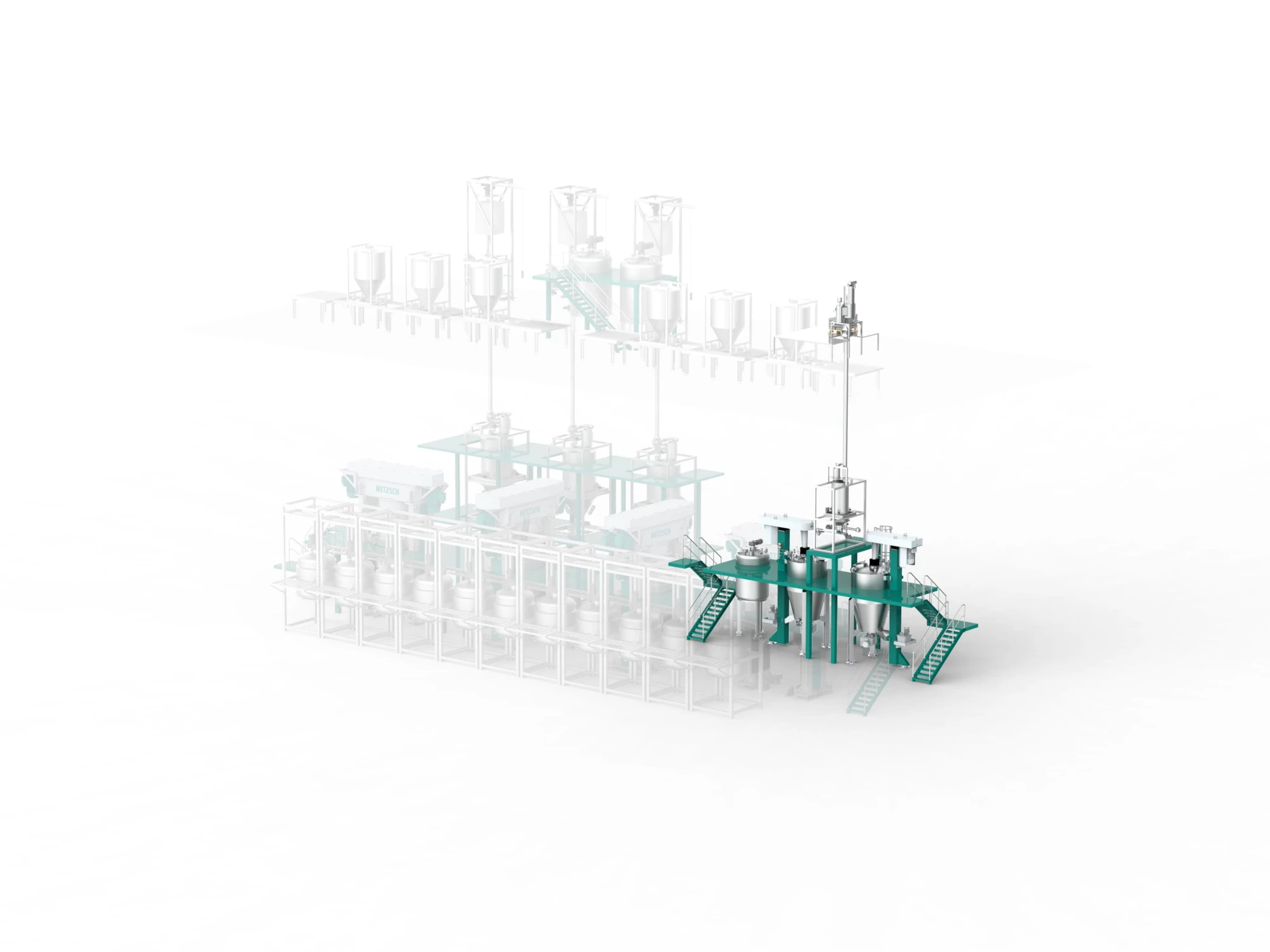
This significantly lowers investment costs, particularly for expensive peripheral equipment such as powder dosing systems, sensors, tanks, and more. Additionally, less manpower is needed to operate the fully automated plant, and the footprint of the mixing area is minimized. Battery customers are on tight schedules, and the smaller footprint also facilitates faster installation and commissioning.
Anode | Cathode | ||||
|---|---|---|---|---|---|
Type of Planetary Mixer | Conventional | NETZSCH | Conventional | NETZSCH | |
Typical Mixing Time | 270 min | 120 min | 480 min | 180 min | |
Batch size | 1 600 l | 3 300 l | 1 600 l | 3 300 l | |
Number of Mixers | 24 | 6 | 12 | 3 | |
Big Bag Discharger | 48 | 3 | 24 | 2 | |
Buffer & Storage Tanks | 48 | 12 | 24 | 6 | |
Footprint of mixing block | Width | 25 m | 11.5 m | 25 m | 10 m |
Length | 25 m | 11 m | 25 m | 9 m | |
Height | 7 m | 7 m | 7 m | 7 m | |
*The anode is coated with two layers of slurry and two recipes are needed.
Mixing Time & Energy Saving
Reducing Mixing Time
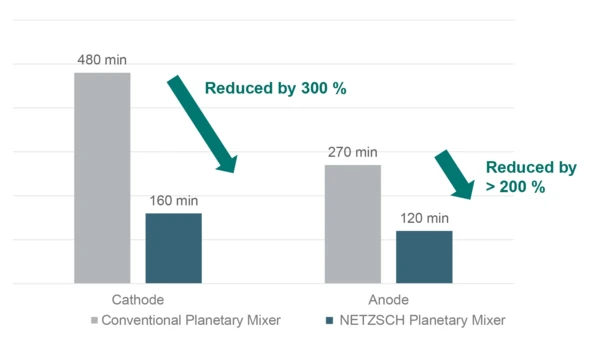
During validation tests, NETZSCH reduced the mixing time significantly by a factor of 2 for anode mixing and factor 3 of cathode mixing. The NETZSCH Planetary Mixers (PMH) mixed the slurry in 120 minutes (Anode) and 160 minutes (Cathode) and delivered even better-quality performance. So, why were the NETZSCH Planetary Mixers so much better, and how does a Planetary Mixer work?
Working Principle
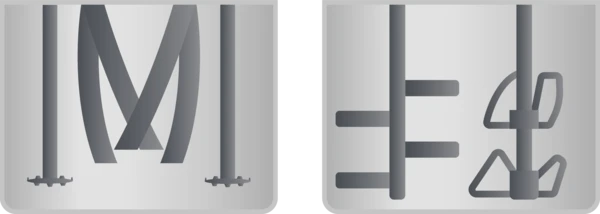
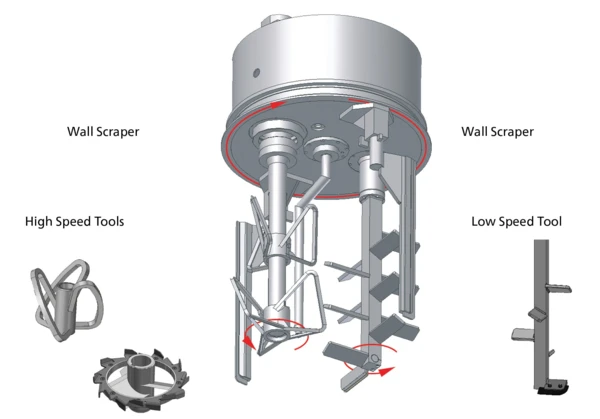
The NETZSCH PMH (Planetary Mixer High Speed) operates with a planetary gearing mechanism. The self-rotating mixing tools, Low-Speed as axial cross beam and High Speed as butterfly tool, perform a rotary movement in a stationary tank and pass through the entire mixing product.
Increasing the diameter of the mixing tools dramatically increases the power input, leading to faster, more efficient, better mixing and a better product quality. The NETZSCH PMH tools have a much larger diameter compared to conventional planetary mixers (Figure 2).
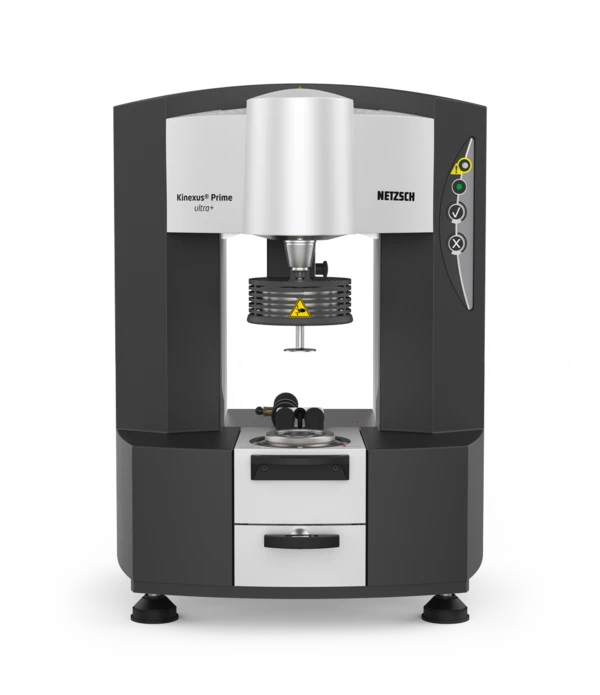
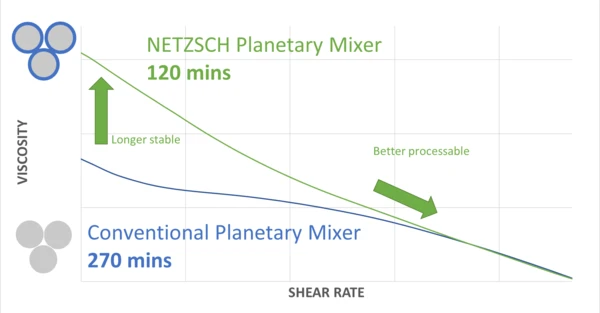
The NETZSCH Analyzing & Testing Business Unit measures flow behavior with the Rotational Rheometer Kinexus (Figure 3). The dependence of viscosity on different shear rates is important and provides significant information about quality. One key factor is the stability of the produced slurry. During production, waiting times can occur, and direct feeding of the coater is not always guaranteed. It's important to have a slurry that doesn't sediment quickly and has a longer storage time, indicated by higher viscosity at lower shear rates (Figure 4). This is due to better wetting and dispersing of the particles, resulting from higher energy input due to the unique design. Moreover, the coating process improves yields, sharper edges, and avoids smearing.
Another important factor is processability and flow rate. The slurry is transferred via a slot die to the collector foil. To prevent blockage, a shear-thinning effect is important. The slot generates high shear rates, and a steep viscosity slope is needed for a fast coating process. It's important to have a high slope of the viscosity curve, resulting in lower viscosity at higher shear rates, as shown in Figure 4.
Improved Performance Through Enhanced Kneading Phase in the Mixing Process
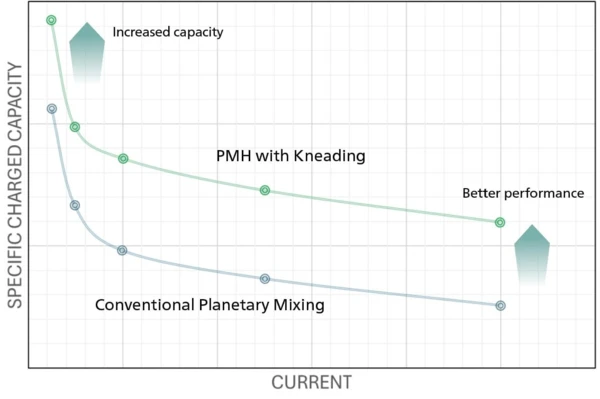
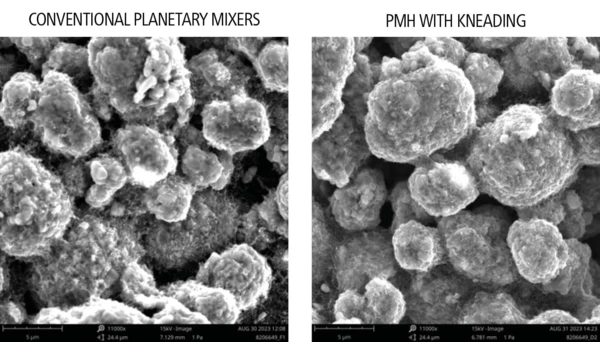
Recent tests have shown significant improvements in battery performance due to the optimized kneading phase during the mixing process with the NETZSCH PMH. A more homogeneous distribution of material is achieved by kneading which leads to the following advatages:
- Higher Performance: The uniform mixing of components results in better material connectivity, enhancing the overall efficiency of the battery. This ensures that energy is transferred more effectively, leading to increased capacity and longer battery life.
- High Charge Percolation: The improved homogeneity also facilitates higher charge percolation within the electrode structure. This allows for more efficient charge transport, reducing resistance and enabling faster charging cycles without compromising battery stability.
These improvements highlight the critical role of a well-executed kneading phase, showing clear advantages in terms of both performance and energy management.
Silicon Anodes in Future Batteries
Addressing Challenges in Mixing and Hydrogen Formation
Silicon anodes are gaining increasing interest for future batteries due to their superior performance potential. However, conventional planetary mixers often introduce problems during the mixing process, particularly due to the high shear forces they generate. These forces can fracture the sensitive Graphite-Silicon-Composite, leading to unwanted side effects such as hydrogen formation.
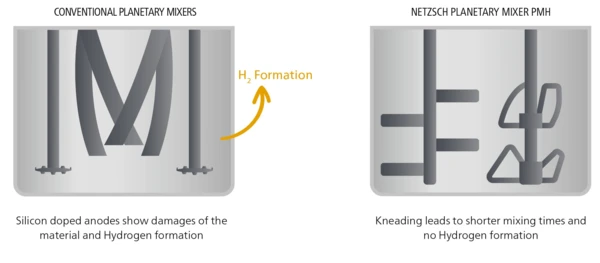
Conventional planetary mixers, which rely on high-shear dispersion discs (Figure 7, left), can damage crucial components like binders or active materials. This results in compromised battery performance and material degradation. In contrast, NETZSCH mixing tools are specifically engineered to minimize shear forces while enabling a softer and more controlled kneading process. This design allows the mixer to operate at higher speeds without damaging the binder structure of the battery slurry or triggering hydrogen production.
Another practical example of the benefits of advanced mixing techniques can be seen in the preparation of water-based anode slurries containing carboxymethylcellulose (CMC), a polymer with long chains and high molecular mass. Conventional planetary mixers often exert excessive mechanical stress on these polymer chains, causing fragmentation. This leads to undesirable changes in slurry viscosity, such as shear thickening, which renders the slurry unsuitable for subsequent coating processes.
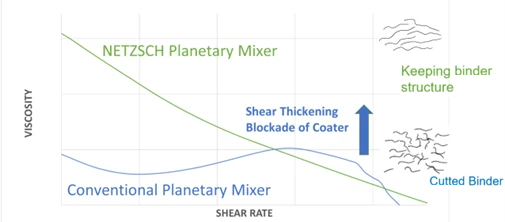
In contrast, NETZSCH’s innovative mixing tools apply a gentler kneading action that preserves the integrity of CMC chains. This approach maintains consistent slurry viscosity, ensuring homogeneous mixing and producing a uniform coating of the active material. The result is a high-quality slurry that supports improved battery performance without the risks associated with conventional high shear mixing methods.
From Lab to Gigafactory
Scalable Mixing for Every Stage
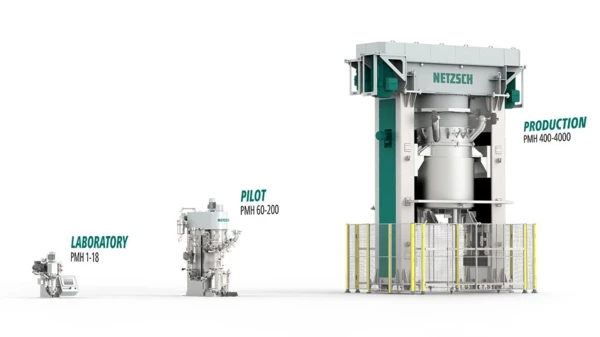
To accelerate the development of new battery chemistries, the NETZSCH PMH planetary mixer is available in a range of sizes, from laboratory to pilot and full-scale production models. A key advantage of the NETZSCH mixers is the consistent ratio of vessel diameter to mixing tools across all machine sizes. This uniformity ensures seamless and efficient scaling from one machine size to the next, enabling faster transitions during the development process.
Additionally, our dedicated battery team and state-of-the-art battery laboratory provide expert support, assisting customers in developing and optimizing cell chemistry to meet their performance goals.
Model | Total Volume in l | Effective Volume in l |
|---|---|---|
PMH 1 | 1.6 | 0.3 - 1.2 |
PMH 10 | 10 | 3 - 7 |
PMH 18 | 18 | 6 - 14 |
PMH 60 | 50 | 18 - 38 |
PMH 100 | 90 | 30 - 70 |
PMH 200 | 185 | 50 - 140 |
PMH 400 | 320 | 110 - 250 |
PMH 750 | 600 | 210 - 470 |
PMH 1000 | 1000 | 350 - 775 |
PMH 1400 | 1300 | 425 - 980 |
PMH 1600 | 1600 | 550 - 1250 |
PMH 2300 | 2300 | 700 - 1600 |
PMH 4000 | 4250 | 1200 - 3350 |
Flexibility
However, the PMH is not limited to a single technology. Its special design and high flexibility in changing mixing tools allow the planetary mixer to be used for various other applications in the battery industry, ensuring process security. One mixer or plant can cover multiple applications, including:
- Different cell chemistry with fluctuations of the solid content (e.g. LFP, LMFP, NMC, ...)
- Mixing of solid-state batteries with high viscosities
- Production of thermal insulation material for battery modules
- Fast mixing of dry battery electrodes without any solvent, with flexible change of geometries
- Sodium-ion batteries
Depending on the application, the mixing tools can be changed in minutes by the customer and no service is needed.
17 Reasons Why
7: Wall Scraper
10: Accurate Dosing
8: Fast Discharge
11: Vacuum Function
9: Easy Cleaning
12: Inert Function
At a Glance
Example: Gigafactory for 20 GWh/a
Anode (two recipes*) | Cathode | |||||
|---|---|---|---|---|---|---|
Type of Planetary Mixer | Conventional | NETZSCH | Conventional | NETZSCH | ||
Typical Mixing Time | 270 min | 120 min | 480 min | 180 min | ||
Batch size | 1 600 l | 3 300 l | 1 600 l | 3 300 l | ||
Number of Mixers | 24 | 6 | 12 | 3 | ||
Big Bag Discharger | 48 | 3 | 24 | 2 | ||
Buffer & Storage Tanks | 48 | 12 | 24 | 6 | ||
Footprint of mixing block | Width | 25 m | 11.5 m | 25 m | 10 m | |
Length | 25 m | 11 m | 25 m | 9 m | ||
Height | 7 m | 7 m | 7 m | 7 m | ||
Technical Availability | < 90 % | 95 % | < 90 % | 95 % | ||
Total Investment | Middle | Low | ||||
Cost of Operation | High | Lower | ||||
Energy Consumption | 100 % | 50 % (80 kWh/t) | ||||
Maintenance | High due to more equipment | Low | ||||
Cleanability | Longer pipes and more | Clean-in-Place, short, |
| |||
Installation | Medium | Short due to skid system | ||||
Traceability | Problematic | High degree with | ||||
Automation | Low level | High level | ||||
Tolerance | Problematic | High dosing accuracy | ||||
Emission of dust & solvent | High | Low | ||||
Carbon Footprint | Middle | Low | ||||
Flexibility | Low | High | ||||
*The anode is coated with two layers of slurry and two recipes are needed.