

제품 소개
NETZSCH-Beads® 연삭 미디어
Always the Right Choice
그라인딩 볼 또는 그라인딩 비드라고도 하는 연삭재는 교반기 볼 밀과 같이 자유롭게 움직이는 연삭재가 있는 밀에서 도구 역할을 합니다.
The movement of these grinding balls within the mill generates various stresses between the balls and the product, including impact, pressure, friction, and shear.
These interactions enable a range of processes. Depending on the particular product and task at hand, these could include size reduction, dispersion, or deagglomeration processes, as well as emulsification, cell disruption, or homogenization.
As the tools of the ball mill, the media have a crucial impact on the outcome of the dispersion or wet grinding process. Therefore, the selection of suitable media represents a key optimization feature. Used media should be matched to the characteristics of the raw materials, the objectives of the process, as well as the milling technology employed.
We assist you in selecting the right grinding media, ensuring that with the use of NETZSCH-Beads®, you achieve optimal results in terms of energy efficiency, production output, wear and maintenance cost, operational reliability, and sustainability.
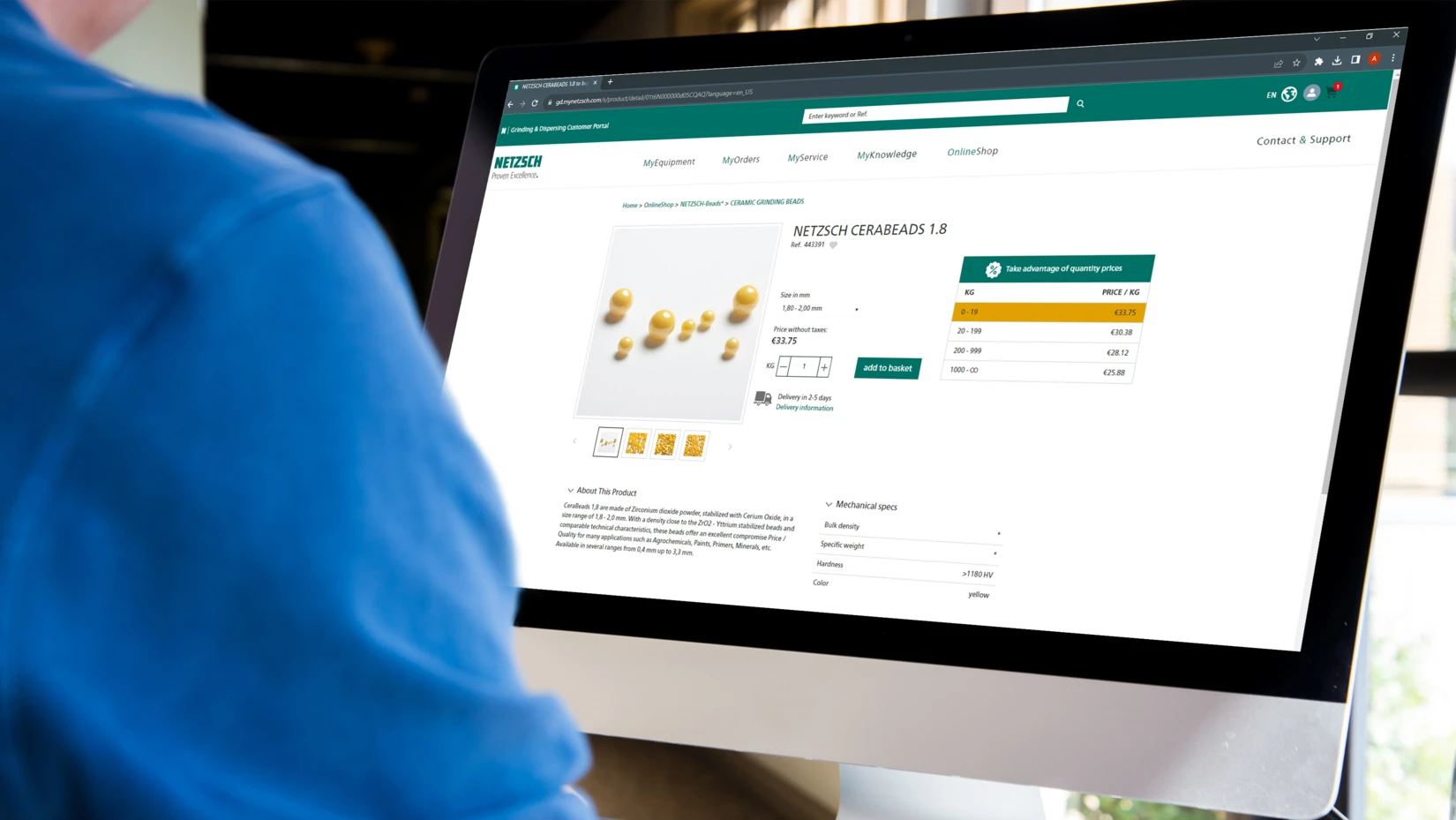
다음과 같은 이점을 경험하세요 NETZSCH-Beads®
- NETZSCH 교반식 비드 밀에 이상적으로 적합한 연마 비드
- 모든 주요 사양을 원하는 크기로 제공
- 기계, 분쇄 도구 및 용도의 최적의 조합
- 제품 품질 향상
- 공정 최적화 및 생산 능력 증대
- 에너지 효율 향상
- 뛰어난 연마 비드 품질
Our Special Service for you
당사의 응용 연구소에서 고객님과 함께 예비 테스트를 진행하여 최적의 분쇄 매체를 선정하고 교반식 비드 밀의 이상적인 작동 매개변수를 결정하기 위해 귀사와 함께 예비 테스트를 수행할 수 있습니다.
이 시험은 실험실 규모는 물론 파일럿 플랜트에서도 수행할 수 있습니다. 귀사를 저희 시설로 초대하여 시험 과정을 직접 참관하시고, 당사의 응용 전문가들과 긴밀히 의견을 나누시기를 진심으로 권해 드립니다.
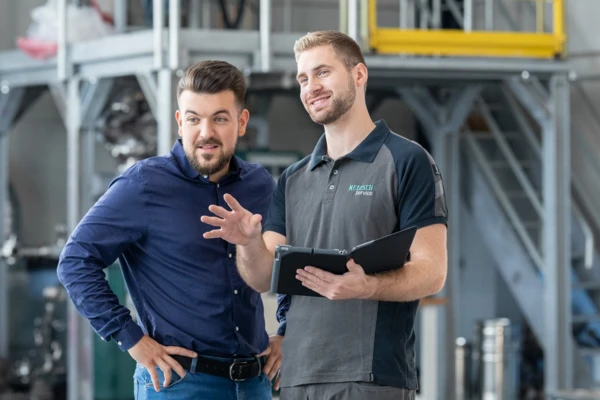
교반식 비드 밀을 완벽하고 효율적으로 가동하려면, 사용 중인 연마 비드( NETZSCH-Beads® )의 직경과 모양을 정기적으로 점검해야 합니다. 연마 비드가 최소 크기에 도달하면, 스크린 막힘과 같은 밀의 가동 문제가 발생하거나, 일반적인 가동 시간 내에 제품 품질을 더 이상 달성할 수 없게 될 수 있습니다. 사양에 더 이상 부합하지 않는 분쇄 비드를 걸러내고 NETZSCH-Beads® 에서 새로운 비드로 보충할 수 있습니다. 기꺼이 조언해 드리겠습니다.
Boosting production efficiency with NETZSCH-Beads®
적합한 연마 매체를 사용하면 교반식 비드 밀의 에너지 효율과 성능을 향상시킬 수 있습니다. 물론, 선정 과정에서는 밀도와 연마 비드 크기뿐만 아니라 마모, 밀 회전 속도 및 에너지 소비량도 종합적으로 고려합니다. 추가 문의 사항이 있으시면 당사의 전문가들이 기꺼이 도와드리겠습니다.


FAQ - What you should know
Grinding media can be made from steel, ceramic, glass, or other materials. They are the tools used in mills with free-moving grinding media, such as agitator bead mills. The requirements for the grinding bodies can vary greatly depending on the industry, such as food, pharmacy, battery and nanotechnology, or basic chemicals in terms of quality, price, material composition, sterilizability, and morphology. With NETZSCH-Beads®, we always provide the right tools for your product requirements.
Agitator bead mills are typically operated with a grinding media filling level of up to 90%. The grinding balls are set in motion by an agitator, which is equipped with pins, discs or similar activation elements. The intense motion of the grinding media leads to collisions between the grinding bodies and the activation elements, the grinding chamber wall, or other grinding balls. Product particles are stressed during these contacts through pressure, impact, friction, and shear. The stress conditions depend very strongly on the size of the grinding body, the density of the grinding body, but also on the speed of the agitator shaft and the grinding system used.
The selection of optimal media depends on various factors. Influences on the selection include not only the hardness, density, or viscosity of the products to be processed, but also the desired particle size and quality demands on the product.
For instance, steel balls are characterized by very high density and their magnetic properties. In contrast, glass grinding balls are grinding bodies with a relatively low density and hardness, but they are interesting for the processing of materials with low hardness due to their low price.
Ceramic balls have an extremely high hardness, fracture toughness, and excellent chemical resistance as well as wear resistance. In addition, ceramic grinding bodies in NETZSCH-Beads® quality are very resistant to grinding body breakage.
The grinding beads quality, including the internal structure, the shape of the balls, and the surface condition, have a direct influence on the product quality, the wear of grinding bodies, and the operational safety of the grinding process.
NETZSCH offers a wide range of different grinding bodies that are tailored to the requirements of different applications. Since the grinding media used have a direct influence on the product quality and on the efficiency of the grinding or dispersion process, guarantees and performance commitments for NETZSCH mills can only be given when it is ensured that the used grinding balls have the corresponding quality and wear resistance.
Ceramic materials like zircon silicate, zirconium oxide, or aluminum oxide are typical materials for the production of grinding balls.
For the production of ceramic grinding bodies, different shaping methods are applied depending on the material and size. Typically, these are agglomeration, pressing, melting, spraying, or droplet processes.
Larger grinding bodies with diameters of more than 5 mm are often produced by pressing granulated powders with additives uniaxially or isostatically into balls or cylinders. Agglomeration processes can take place, for example, in fluidized bed granulators, granulating discs, pelletizers, or kneading mixers. With agglomeration processes, spherical grinding balls of about 0.3 to 0.5 mm can be produced.
Ceramic balls, for example, of zircon silicate with diameters in the range of about 0.5 to 4 mm are produced in large quantities by means of a melting process. Particularly in the production of grinding balls through a melting process, there is a risk of ball breakage due to possible inclusions and cavities. Ball breakage contaminates the ground material and can damage the mill. Particularly at risk are the grinding body separation devices such as separation gaps, sieve gaps and sieve cartridges as well as the mechanical seal.
Ceramic balls in the diameter range up to 3.5 mm can be produced in large quantities by means of spray and droplet processes. If the grinding media are produced by spraying and droplet processes, a drying, debinding, and a sintering process follow the shaping. During drying, a temperature profile must be implemented over the drying time in the aggregate, which allows homogeneous drying of the balls without damaging the structure and without crack formation. The dried ceramic balls are subjected to a rounding process after drying, as the balls in this state still have a relatively easy-to-work surface.
The dried and rounded ceramic balls are now subjected to a debinding and sintering process following a special temperature profile, which in turn has a decisive influence on the mechanical properties of the balls. The temperature profile during the debinding and firing process is responsible for the homogeneity and the microstructure of the resulting ceramic balls.
The grinding beads produced in this way are sorted and classified according to their roundness. The roundness, as well as the fraction width of the beads, have a direct influence on the product quality and on the wear. An additional quality increase of the balls can be achieved by the so-called conditioning. Here, the surfaces of the grinding beads are polished to reduce the abrasion during the later grinding in the stirred ball mill. Polishing is carried out in polishing drums with diamond pastes.
Your Service Contact at NETZSCH
Any specific questions? Contact us for help.