Produits & Solutions
NETZSCH-Beads® Supports de broyage
Always the Right Choice
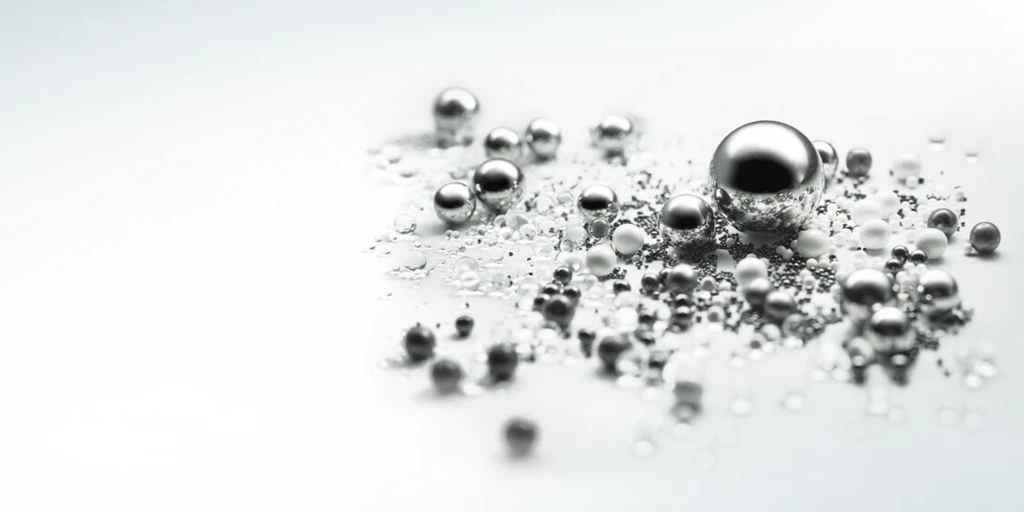
Les médias de broyage, également appelés billes de broyage, servent d'outils dans les broyeurs dont les médias de broyage se déplacent librement, tels que les broyeurs à billes à agitateur.
The movement of these grinding balls within the mill generates various stresses between the balls and the product, including impact, pressure, friction, and shear.
These interactions enable a range of processes. Depending on the particular product and task at hand, these could include size reduction, dispersion, or deagglomeration processes, as well as emulsification, cell disruption, or homogenization.
As the tools of the ball mill, the media have a crucial impact on the outcome of the dispersion or wet grinding process. Therefore, the selection of suitable media represents a key optimization feature. Used media should be matched to the characteristics of the raw materials, the objectives of the process, as well as the milling technology employed.
We assist you in selecting the right grinding media, ensuring that with the use of NETZSCH-Beads®, you achieve optimal results in terms of energy efficiency, production output, wear and maintenance cost, operational reliability, and sustainability.
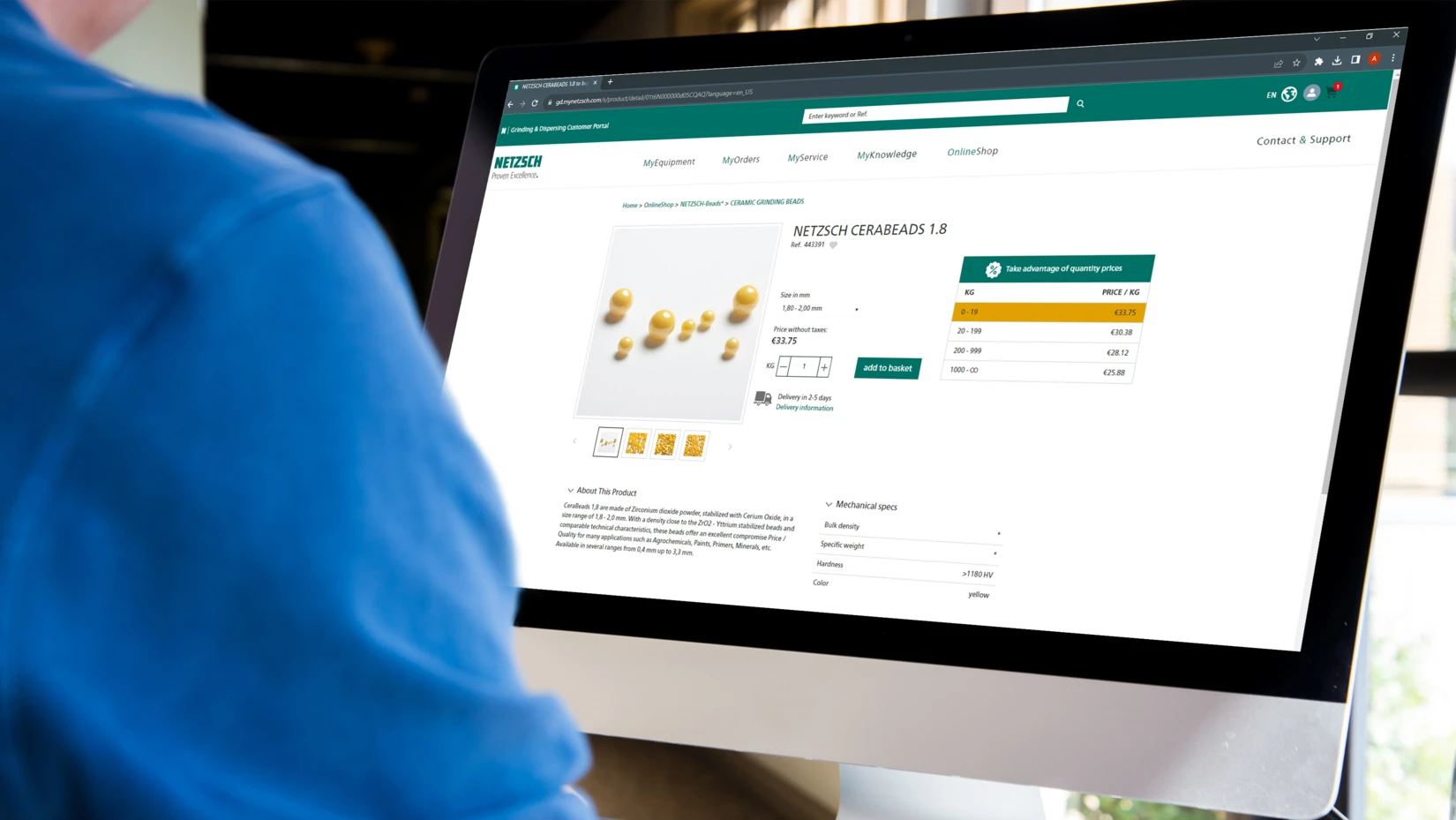
Découvrez les avantages de NETZSCH-Beads®
- Des billes de broyage parfaitement adaptées aux broyeurs à billes à agitateur NETZSCH
- Toutes les qualités essentielles sont disponibles dans les tailles souhaitées
- Combinaison optimale entre la machine, l'outil de broyage et l'application
- Amélioration de la qualité du produit
- Optimisation des processus et augmentation de la capacité
- Meilleure efficacité énergétique
- Excellente qualité des billes de broyage
Our Special Service for you
Nous pouvons réaliser avec vous des essais préliminaires dans nos laboratoires d'application, afin de sélectionner le milieu de broyage et de déterminer les paramètres de fonctionnement idéaux pour le broyeur à billes avec agitateur.
Les essais peuvent être réalisés aussi bien à l'échelle du laboratoire que dans l'usine pilote. Nous vous invitons cordialement à assister aux essais dans nos locaux et à échanger étroitement avec nos spécialistes en applications.
Pour garantir un fonctionnement optimal et efficace de votre broyeur à billes à agitation, vous devez vérifier régulièrement le diamètre et la forme des billes de broyage ( NETZSCH-Beads® ) que vous utilisez. Si une bille de broyage atteint sa taille minimale, cela peut entraîner des problèmes de production au niveau du broyeur, tels que des tamis obstrués, ou empêcher d’obtenir la qualité de produit souhaitée dans les délais habituels. Il est possible de trier les billes de broyage qui ne répondent plus aux spécifications et de les remplacer par des billes de broyage « NETZSCH-Beads® ». Nous nous ferons un plaisir de vous conseiller.
Boosting production efficiency with NETZSCH-Beads®
En utilisant le type de billes de broyage le mieux adapté, vous pouvez améliorer le rendement énergétique et les performances de votre broyeur à billes à agitation. Bien entendu, outre la densité et la taille des billes de broyage, nous prenons également en compte l'usure, la vitesse de broyage et la consommation d'énergie lors du processus de sélection. Si vous avez d'autres questions, nos experts se feront un plaisir de vous aider.
Our Grinding Media Products:
 Billes de meulage en acier SteelBeads Micro
 Billes de meulage en acier SteelBeads Q
 Billes de meulage en verre GlassBeads
 Billes de broyage en céramique ZetaBeads® Plus
 Billes de broyage en céramique ZetaBeads® Nano
 Billes de broyage en céramique VitaBeads® Nano
 Billes de broyage en céramique CeraBeads
 Billes de broyage en céramique ZsBeads
FAQ - What you should know
Grinding media can be made from steel, ceramic, glass, or other materials. They are the tools used in mills with free-moving grinding media, such as agitator bead mills. The requirements for the grinding bodies can vary greatly depending on the industry, such as food, pharmacy, battery and nanotechnology, or basic chemicals in terms of quality, price, material composition, sterilizability, and morphology. With NETZSCH-Beads®, we always provide the right tools for your product requirements.
Agitator bead mills are typically operated with a grinding media filling level of up to 90%. The grinding balls are set in motion by an agitator, which is equipped with pins, discs or similar activation elements. The intense motion of the grinding media leads to collisions between the grinding bodies and the activation elements, the grinding chamber wall, or other grinding balls. Product particles are stressed during these contacts through pressure, impact, friction, and shear. The stress conditions depend very strongly on the size of the grinding body, the density of the grinding body, but also on the speed of the agitator shaft and the grinding system used.
The selection of optimal media depends on various factors. Influences on the selection include not only the hardness, density, or viscosity of the products to be processed, but also the desired particle size and quality demands on the product.
For instance, steel balls are characterized by very high density and their magnetic properties. In contrast, glass grinding balls are grinding bodies with a relatively low density and hardness, but they are interesting for the processing of materials with low hardness due to their low price.
Ceramic balls have an extremely high hardness, fracture toughness, and excellent chemical resistance as well as wear resistance. In addition, ceramic grinding bodies in NETZSCH-Beads® quality are very resistant to grinding body breakage.
The grinding beads quality, including the internal structure, the shape of the balls, and the surface condition, have a direct influence on the product quality, the wear of grinding bodies, and the operational safety of the grinding process.
NETZSCH offers a wide range of different grinding bodies that are tailored to the requirements of different applications. Since the grinding media used have a direct influence on the product quality and on the efficiency of the grinding or dispersion process, guarantees and performance commitments for NETZSCH mills can only be given when it is ensured that the used grinding balls have the corresponding quality and wear resistance.
Ceramic materials like zircon silicate, zirconium oxide, or aluminum oxide are typical materials for the production of grinding balls.
For the production of ceramic grinding bodies, different shaping methods are applied depending on the material and size. Typically, these are agglomeration, pressing, melting, spraying, or droplet processes.
Larger grinding bodies with diameters of more than 5 mm are often produced by pressing granulated powders with additives uniaxially or isostatically into balls or cylinders. Agglomeration processes can take place, for example, in fluidized bed granulators, granulating discs, pelletizers, or kneading mixers. With agglomeration processes, spherical grinding balls of about 0.3 to 0.5 mm can be produced.
Ceramic balls, for example, of zircon silicate with diameters in the range of about 0.5 to 4 mm are produced in large quantities by means of a melting process. Particularly in the production of grinding balls through a melting process, there is a risk of ball breakage due to possible inclusions and cavities. Ball breakage contaminates the ground material and can damage the mill. Particularly at risk are the grinding body separation devices such as separation gaps, sieve gaps and sieve cartridges as well as the mechanical seal.
Ceramic balls in the diameter range up to 3.5 mm can be produced in large quantities by means of spray and droplet processes. If the grinding media are produced by spraying and droplet processes, a drying, debinding, and a sintering process follow the shaping. During drying, a temperature profile must be implemented over the drying time in the aggregate, which allows homogeneous drying of the balls without damaging the structure and without crack formation. The dried ceramic balls are subjected to a rounding process after drying, as the balls in this state still have a relatively easy-to-work surface.
The dried and rounded ceramic balls are now subjected to a debinding and sintering process following a special temperature profile, which in turn has a decisive influence on the mechanical properties of the balls. The temperature profile during the debinding and firing process is responsible for the homogeneity and the microstructure of the resulting ceramic balls.
The grinding beads produced in this way are sorted and classified according to their roundness. The roundness, as well as the fraction width of the beads, have a direct influence on the product quality and on the wear. An additional quality increase of the balls can be achieved by the so-called conditioning. Here, the surfaces of the grinding beads are polished to reduce the abrasion during the later grinding in the stirred ball mill. Polishing is carried out in polishing drums with diamond pastes.
Your Service Contact at NETZSCH
Any specific questions? Contact us for help.