Introduction
Digital inkjet printing has transformed the decoration of ceramic tiles, offering high flexibility in design while enabling efficient and reproducible production. At the same time, the technology places demanding requirements on ceramic inks. Particle size and particle size distribution, rheology, stability and color strength all influence the performance of the ink and ultimately the quality of the printing process.
The preparation of ceramic pigments therefore plays a decisive role. The challenge is not simply to achieve very small particles, but to produce a suitable and controlled particle size distribution while maintaining the functional properties of the pigment.
NETZSCH addresses this challenge by combining ultrafine dry grinding with subsequent wet grinding. The s-Jet® Steam Jet Mill prepares the ceramic pigment for the downstream wet process, while the Zeta® agitator bead mill performs the final fine grinding and dispersion. By considering both technologies as part of one integrated process, grinding efficiency and the properties of the finished ink can be optimized simultaneously.
Challenge of Submicron Grinding
Producing ceramic inks for digital printing requires pigments in the submicron range. Wet grinding with small grinding media can achieve the required fineness, but increasingly long grinding times are required as the particles become finer.
Intensive wet grinding can also increase the proportion of very fine particles in the product. An excessive ultrafine fraction may influence important properties such as rheology, pigment reactivity and color characteristics.
The objective is therefore to reach the required final particle size efficiently while maintaining a narrow and controlled particle size distribution.
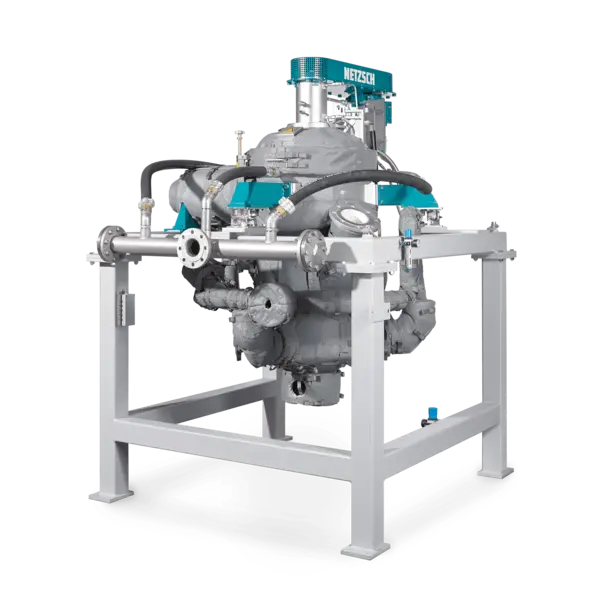
Ultrafine Dry Grinding with the s-Jet®
The s-Jet® Steam Jet Mill extends the operating range of conventional fluidized bed jet milling into the submicron range. Instead of compressed air, the system uses superheated steam as the grinding gas.
The significantly higher jet velocity of steam provides the energy required for ultrafine grinding. In combination with integrated classification, ceramic pigments can be produced with a very fine and narrow particle size distribution.
For Ceramic Inkjet applications, particle sizes of approximately d50 = 0.45 µm and d99 < 1.2 µm have been achieved. Depending on the feed material and operating conditions, values of d97 < 1.2 µm are possible.
The use of high-pressure superheated steam at approximately 40 bar and 250 to 350 °C enables the pigment to be brought close to the required final fineness before entering the wet grinding process.
Final Wet Grinding with the Zeta® System
Following dry grinding, the pigment is dispersed and processed to its final specification in the wet grinding stage.
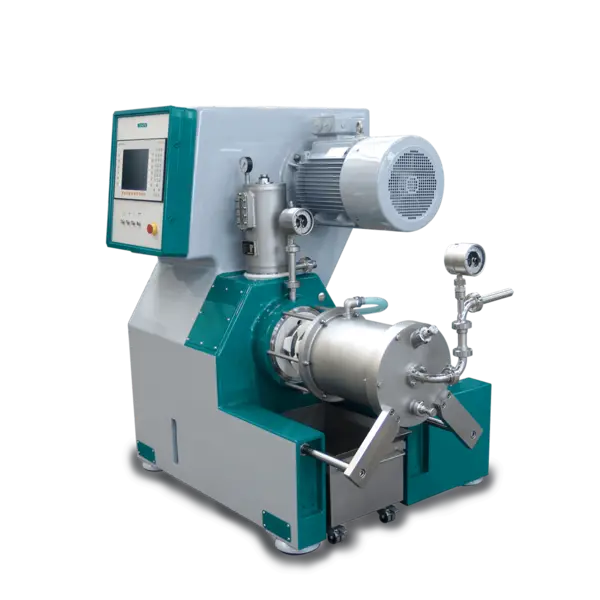
The Zeta® agitator bead mill is designed for circulation operation and provides a high energy input combined with precise process control. The grinding system enables narrow and reproducible particle size distributions while providing high productivity.
For Ceramic Inkjet production, this is particularly important because the task of the wet grinding stage changes when an s-Jet®-pretreated pigment is used. Instead of performing the majority of the particle size reduction, the wet mill can concentrate on achieving the final required particle size distribution and dispersion quality.
The Zeta® technology also provides a scalable approach from laboratory development to production. The equipment range extends from the LabStar laboratory mill to production systems such as the Zeta® 400.
Integrated Dry and Wet Grinding Process
The main advantage results from considering dry and wet grinding as a single process rather than as two independent production steps.
The s-Jet® produces an ultrafine pigment with a narrow particle size distribution before wet grinding begins. Consequently, considerably less particle size reduction has to be performed in the agitator bead mill.
Process experience has shown that the required wet grinding time can be reduced by up to 50% when pigments pretreated with the s-Jet® are used.
This reduction in wet grinding time provides several benefits. In addition to increasing the effective capacity of the wet grinding equipment, shorter processing times can reduce the formation of unwanted ultrafine particles.
The resulting process therefore focuses not only on achieving a target particle size, but also on controlling the complete particle size distribution.
Particle Size Distribution and Ink Properties
Particle size distribution is particularly important in Ceramic Inkjet applications because it can influence several properties of the finished ink.
A controlled distribution contributes to:
- stable rheological behavior
- good filterability
- controlled pigment reactivity
- consistent color characteristics
- reliable further processing
The combination of ultrafine dry grinding and shorter wet grinding can also reduce the quantity of extremely fine pigment particles generated during prolonged bead milling.
Process experience with yellow and red-brown ceramic pigments has demonstrated that the resulting particle size distribution can have a positive effect on color strength.
Rather than maximizing the intensity of a single grinding step, the combined process distributes the required particle size reduction between two complementary technologies.
Greater Efficiency in Ceramic Inkjet Production
The integrated process concept provides benefits for both product quality and production efficiency.
Up to 50% Shorter Wet Grinding Time
Higher Wet Grinding Capacity
Reduced Formation of Ultrafines
Controlled Particle Size Distribution
Optimized Color Performance
Scale-up from Laboratory to Production
From Pigment Preparation to the Finished Ink
The production of Ceramic Inkjet ink involves more than an individual grinding machine. Dry grinding, mixing and dispersing, wet grinding and process control all contribute to the properties of the final product.
By combining these process steps, NETZSCH can evaluate the complete production chain from ceramic pigment to finished ink. Laboratory testing can be used to determine suitable operating parameters, particle size distributions and grinding conditions before transferring the process to production scale.
This integrated approach enables the individual process steps to be matched to one another instead of optimizing each machine independently.
Conclusion
Efficient Ceramic Inkjet production is not simply a question of achieving the smallest possible particle size. The decisive factor is how the required particle size distribution is achieved.
Combining ultrafine dry grinding with the s-Jet® Steam Jet Mill and controlled wet grinding with the Zeta® System distributes particle size reduction intelligently across the production process.
The s-Jet® prepares a fine, narrowly distributed pigment before wet grinding begins. The Zeta® System can then focus on achieving the required final fineness and dispersion quality. As a result, the required wet grinding time can be reduced by up to 50%, while simultaneously limiting the formation of unwanted ultrafine particles.
The result is an integrated process designed to combine high productivity, controlled particle size distribution and optimized Ceramic Inkjet ink properties.