26.08.2016
亚微米级干法精细研磨 - 产量提高五倍
在每个研磨过程中,无论是湿法还是干法,细颗粒都有重新聚集的趋势。颗粒越细,这种趋势就越明显。
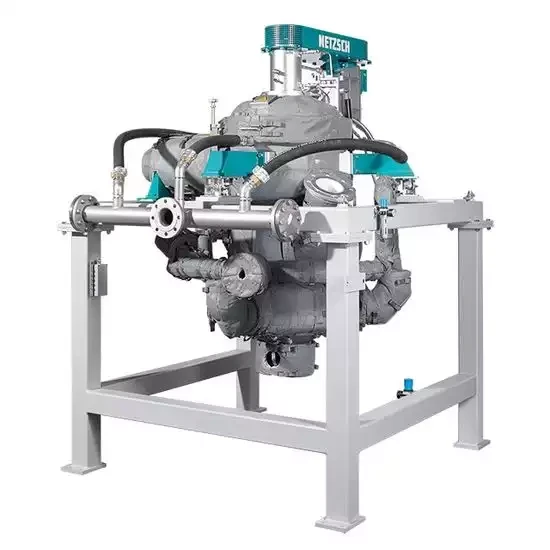
During dry-grinding this formation of agglomerates causes a decrease in throughput capacity and reduces the process efficiency. The classifier in a fluidized bed jet mill cannot discern individual fine particles, but rather recognizes the agglomerate as one large particle which is then reintroduced into the grinding process. In a closed system such as a fluidized bed jet mill, the agglomerates thus remain in the mill, ostensibly to be ground even finer.
Prevention of Reagglomeration
In particular for the NETZSCH s-Jet®® process by NETZSCH Trockenmahltechnik, in which steam is used as a grinding medium instead of air to give higher capacities and to open up new ranges of fineness (submicron) for the dry-grinding sector, the stabilization of the finest particles produced is of great importance. This is done by adding suitable dispersing agents. If the amount of dispersing agent added is approx. 0.1 to 1 %, this decreases the electrostatic surface charge thus reducing reagglomeration. Depending on the product and additive used, the result is not just a fivefold increase in throughput, but also an improvement of the flowability, an increase in the surface area and a reduction of product deposits in the mill.
Use of Dispersing Agents
In the NETZSCH s-Jet®® process dispersing agents can be added in solid or liquid form. Solid agents are fed directly into the feed product via a dosing device whereas liquid agents are usually added via a dosing pump directly into the fluidized bed jet mill.